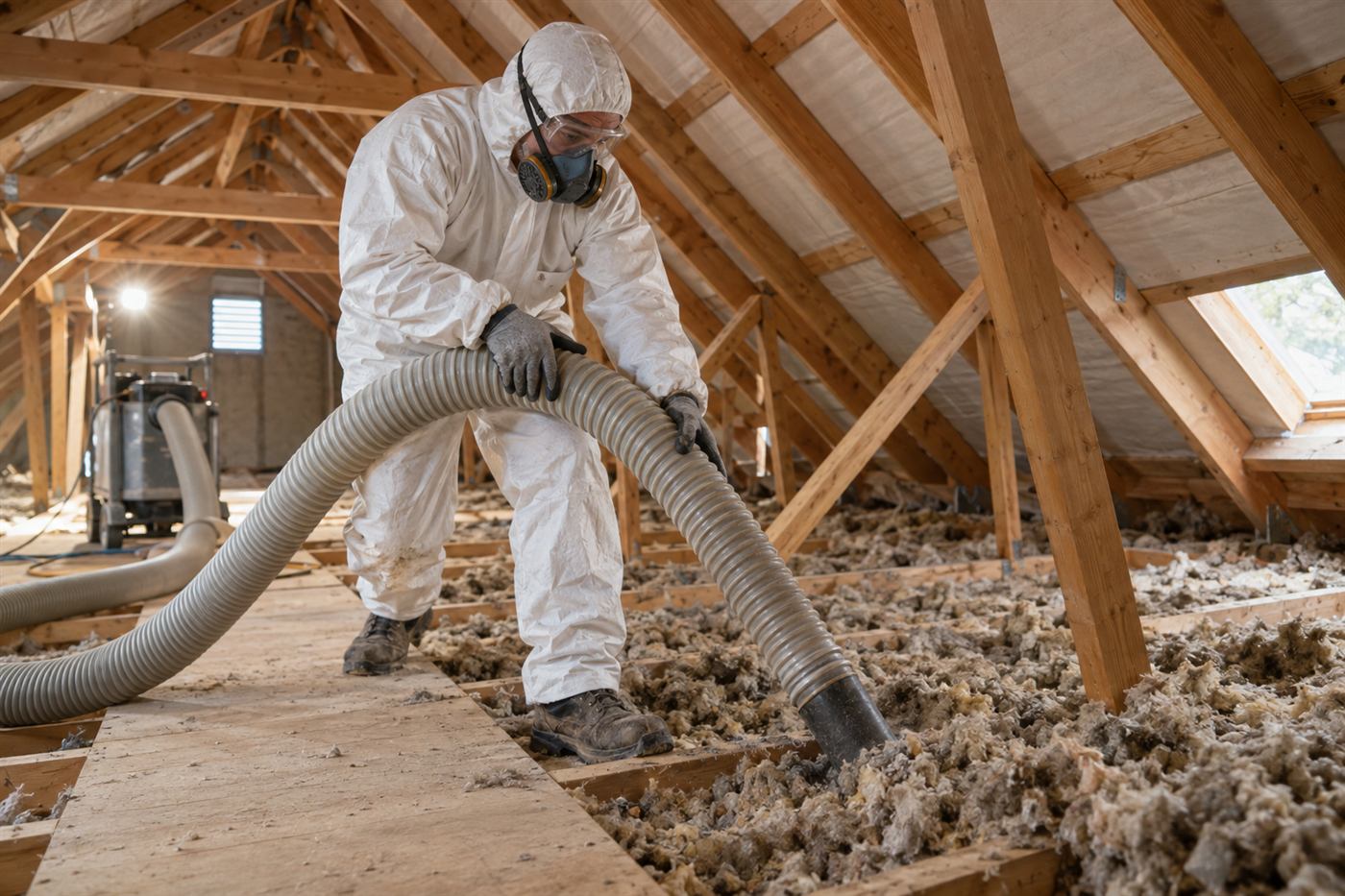
Why removal planning matters more in large Boca attics
Many Boca Raton homes were built with generous attic spaces: ranch houses with long, low rooflines, and larger custom homes in golf and country club communities with complex roof shapes. A large attic holds a lot of insulation, and when something goes wrong in one corner, the effect can spread further than the visible stain on a ceiling.
A single roof leak can wet a surprisingly wide area. Water runs along rafters, drips onto insulation, wicks sideways through fibrous material and settles in low spots. By the time a stain shows on the ceiling below, the damp zone above may be much larger. Treating only the visible area leaves wet material behind, and that moisture can keep feeding mold growth and deteriorating drywall.
Pests create a similar problem. A rodent that enters through a gap in a soffit or a roof penetration may travel across the attic, leaving trails, nests and droppings throughout. The smell or sound of activity may come from only one area, but contamination can be widespread. Removal in that case is about cleaning and sealing, not just pulling out a patch.
Storms add another category. Wind-driven rain during a hurricane or tropical system can push water under tile, around flashing and through vents. Insulation that was dry in May can be soaked in September. A quick, honest inspection after a storm helps decide what is salvageable and what is not.
Tile roofs, high cooling loads and what they mean for the work
Tile roofs are common in Boca Raton. They are durable, but they are also heavy, brittle underfoot and not forgiving of people walking on them. Roof leaks beneath tile often originate at flashing, valleys, penetrations or underlayment failure rather than from the tile itself. That means a leak may be hard to locate from the attic, and the wet insulation may be some distance from the actual entry point.
Large homes also carry large cooling loads. Big attics, tall ceilings and big window areas mean the air conditioner is working hard. When insulation is compromised, the cost shows up in comfort and in how long equipment runs. Owners often notice it first as one room that will not cool or an air handler that runs longer than before.
For removal and replacement, these facts have practical effects. Access in a large attic can be long and awkward, and crews need to plan routes, lighting and ventilation for the space. Ducts and air handlers in the attic must be protected during the work. Debris must be bagged and carried out without scraping finished surfaces.
A well-run project also considers the condition of what is above. If a roof leak is the cause, the roof must be repaired or the source identified before new insulation goes in. Putting fresh material under an active leak is wasteful. Our page on moisture in attic insulation goes into the signs and causes.
Permit review and how to approach it
Boca Raton has a municipal permitting process, and projects of different sizes may be treated differently. Some insulation work, particularly minor replacement within existing cavities, may not require review, while larger or structural scopes might. Because rules and thresholds can change, the safest approach is to ask the installer how they handle permits and to confirm with the city building department if you are unsure.
In gated communities and golf communities, there is often an additional layer of approval from a homeowners association. Interior attic work typically does not alter the exterior appearance, but associations may have rules on contractor access, vehicles, working hours and dumpster or debris placement. Check with the management office early so the schedule is not held up.
If the work follows an insurance claim, the carrier may have its own documentation requirements. Photographs, a written description of damage and receipts are commonly requested. Our guide to permits for insulation work and our page on insulation and insurance claims help you organize these items.
None of this should be intimidating. The point is to avoid surprises. A short conversation with the installer about permits, with the association about access, and with your insurer about documentation, usually clears the path.
- Ask your installer how permit questions are handled for your scope.
- Confirm with the city building department if you are not sure.
- Check community rules on contractor access and debris.
- Keep photographs and written notes if an insurance claim is involved.
How a technician evaluates the damage
Evaluation is the foundation of removal planning. The aim is to understand what failed, what is affected and what should be done in what order. A typical inspection walks through the following.
- Find the source of water or pest entry: roof, flashing, vents, plumbing, air handler drain line or soffit gaps.
- Map the affected area, checking beyond the visible stain for damp or contaminated material.
- Identify the insulation type and condition, including compaction, discoloration and odor.
- Inspect framing and decking for rot, staining or active moisture.
- Check wiring, junction boxes and ducts for damage or contamination.
- Evaluate ventilation paths and whether they are blocked by debris or old material.
- Determine whether any suspicious material needs separate testing before disturbance.
- Plan containment, protection and disposal for the specific home.
Cleaning, sealing and drying before anything new goes in
Reinsulating too early is a common and costly mistake. New material placed over damp framing or a still-active pest entry only sets up the same failure again. The work between removal and replacement matters just as much as either step.
After the old material is out, surfaces should be inspected and cleaned. In pest cases, droppings and nesting debris are removed, and the area may be treated with appropriate cleaning products. Entry points such as gaps at soffits, vents and roof penetrations should be sealed with materials suited to the opening. Pest control specialists may need to be involved if there is an active infestation.
In water cases, framing and decking need time to dry. A technician can check moisture levels and advise on when the area is ready. Any rot or damage found in structural components should be repaired by the appropriate trade before insulation is installed.
Air sealing is a good moment to address gaps around penetrations such as light fixtures, plumbing stacks and wiring, since the area is open and accessible. Our page on air sealing describes the work. Only after these steps is it sensible to install new insulation.
A clear sequence protects your investment: find the cause, remove what is damaged, clean and repair, seal, then insulate. A good installer will walk you through the sequence rather than rushing to the final step.
Choosing replacement material for a Boca attic
Replacement material depends on the attic, the budget conversation you will have by phone, and the condition of what remains. In a large open attic, blown-in loose-fill is often a practical option since it can be applied evenly across big areas and around obstructions. Batts can work where framing is regular. Spray foam can be considered for roof deck applications or sealed attic designs, though that approach changes how the attic behaves and calls for careful planning around ventilation and moisture.
In a humid coastal climate, moisture tolerance matters. Some materials handle occasional dampness better than others, and some should never be used where they might get wet. A technician will weigh these factors for your attic and explain the reasoning. Our guide on fiberglass, cellulose and foam compares them in plain terms.
Coverage depth should be uniform. In large attics, thin spots appear near edges, around ducts and in hard-to-reach corners. Using depth markers and photographing the finished attic is a good way to confirm even coverage. Baffles at the eaves keep insulation from blocking soffit ventilation. Clearance around recessed lights and equipment should be maintained as appropriate for each fixture.
If you are removing material in order to change the whole system, for example moving from old batts to a modern blown-in layer, ask the installer to explain what will happen to the existing air barrier and ventilation. A thoughtful plan keeps those elements intact.
Scenarios from typical Boca Raton homes
A mid-century ranch home in an established neighborhood has a long, low attic. After a summer storm, a ceiling stain appears in the hallway. The technician finds damp, matted insulation across a wide area and traces water to failed flashing near a roof penetration. The roof is repaired, the wet material is removed, the framing is allowed to dry, and new insulation is installed evenly.
A larger home in a golf community has a persistent smell near the primary suite. The attic shows droppings and nesting material along one wall, and evidence of entry at a soffit. A pest specialist addresses the animals, the crew removes and cleans, the entry is sealed, and the attic is reinsulated. The owner is told that sealing is what keeps the problem from returning.
A homeowner who just bought a house notices old, uneven insulation and a few areas with dark staining. The inspection shows older leaks that have been repaired and are now dry, with some material that is intact and some that is compromised. Rather than replacing everything, the plan is to replace the damaged zones and top up the rest to a consistent depth.
After a tropical system, a family finds water dripping from a ceiling fixture. They turn off power to that circuit at the panel, avoid the area and call for help. The technician later finds wet insulation above, which is removed, and a roofer addresses the entry point. Wiring in the affected area is checked by a qualified electrical contractor before it is covered.
Protecting the house while the attic is open
A large attic project moves a lot of material through a finished home, and the protection plan is part of the job. Crews typically lay floor covering from the entry to the attic hatch, protect door frames and corners, and keep a clear path so bags do not scrape paint or tile. In homes with delicate floors, ask what will be used and whether shoe covers are worn.
Heat is a real concern in a South Florida attic. Good crews schedule work with temperature in mind, bring ventilation or fans where practical, and take breaks. A well-run job is steadier and safer than a rushed one, and homeowners should not pressure a crew into skipping those precautions.
Air handlers and ducts in the attic need care. Disturbed duct wrap, crushed flex duct or a dislodged condensate line can cause comfort and water problems later. Ask the installer to check the equipment before and after the work and to tell you about anything that looks worn. If a drain line is clogged or cracked, it is better to learn that now than after new insulation covers the evidence.
Stored belongings in the attic should be moved or covered. If you keep boxes up there, plan to remove them before the visit, and think about whether they need to go back at all. Compressed insulation under boxes is a frequent cause of cold or hot spots, and walkway boards give you a way to store items without squashing the material.
What to have ready and how to call
When you call, describe what you have seen: stains, smells, sounds, or storm damage, where they are, and when you first noticed them. Say whether the home is in a gated community or part of an association. Mention any past roof repairs or pest treatments. Have photographs ready if you can.
Quotes are given only by phone. For simple situations, a quote may be possible from your description. For anything involving unknown conditions, wide damage or hidden spaces, an on-site visit is needed, and there is a service call charge that is explained on the phone before anyone is dispatched.
Before the visit, make sure the attic hatch is clear, pets are secured and anyone who is sensitive to dust knows what is planned. If water is actively entering the home, take safe steps to limit it, and if there is any electrical concern, shut off the affected circuit and keep away. Call 911 for immediate danger.
Our overview of removal and replacement and our guide to preparing for an insulation visit are good companions to this page. When you are ready to talk it through, call and describe your Boca Raton property, and the team will help you decide what to do first.
Questions people ask
How can wet insulation be much larger than the ceiling stain?
Water travels along rafters and wicks through fibrous material, so the damp area above can be much wider than the stain below. A technician checks the surrounding attic, not just the visible spot, so wet material is not left behind to cause later problems.
Should I replace insulation before the roof is repaired?
No. If water is still entering, new insulation will get wet too. Find and fix the source first, let the area dry, and then reinsulate. A technician can help trace the source or tell you which trade should look at the roof.
Do I need a permit for insulation removal and replacement?
It depends on the municipality and the scope. Some work within existing cavities may not require review, while larger projects could. Ask your installer how they handle it and confirm with the city building department if you are unsure.
What if there are still animals in the attic?
An active infestation should be handled by a pest specialist before cleanup. Removing material while animals are present is unsafe and ineffective. After they are gone, entry points must be sealed so the problem does not return.
Will my community require anything from the contractor?
Many gated and golf communities have rules about access, working hours, insurance documentation and debris. Contact your management office early so they can tell you what applies, and share that information with your installer.
How do I get a quote?
Quotes are given only by phone. Simple jobs may be quoted from your description, and complicated work needs an on-site visit with a service call charge explained before dispatch. Call and describe what you are seeing in your home.
Describe the situation by phone and we will tell you what the job involves. Quotes are given by phone. Jobs that cannot be quoted without seeing them need a technician on site, and the service call charge is explained on the phone before anyone is dispatched.
(561) 854-1888Related pages
When the damage turns out to be bigger than it looked
Sometimes a small stain on a ceiling hides a larger problem. A technician opening a Boca Raton attic to check a leak may find insulation matted and discolored across a wider area than expected, or evidence that moisture has been moving along rafters before dropping at one point. Moisture does not always show up where it enters. The crew follows the trail with a light and a meter, noting the extent before making any recommendation. Large attics in Boca Raton can hide a stain far from where the ceiling shows it, so the search covers more than the obvious corner.
When the scope grows, you are told before anything else happens. The crew pauses, shows you photographs, and explains what has changed. They discuss whether the additional area can be handled now or needs to wait for another trade, such as a roofer or a plumber, to fix the source first. Removing and replacing insulation before the source is repaired often means doing the work twice, so sequencing is a real concern, not an upsell. Photographs taken before and after the removal are kept so you and your insurer, if one is involved, can see the same condition.
Pest evidence is another surprise. Droppings, chewed material or nests in the attic may require separate treatment and cleaning, and the technician will recommend a qualified specialist if the problem is active. Cleaning up after animals is not something to rush, and safety gear is used. If the discovery changes the plan, we revise the scope and any quote in writing terms you understand and explain it before work begins. you are welcome to take time to decide. There is no pressure to decide on the day, and the crew will leave the attic safe and clean while you think it over.