Insulation in a city of condos and low-rise buildings
Hallandale Beach has one of the denser housing mixes in Broward County. Along the coast and the main corridors there are tall condo towers with hundreds of units, and in between sit older two and three-story garden apartments, small co-ops and townhome rows. Single-family houses exist, but a large share of the people who call about insulation here are unit owners, landlords or association managers rather than the owner of a freestanding house.
That changes the shape of the work. In a house, the attic belongs to the owner and the decision is simple. In a multi-unit building, the attic, the roof, the walls between units and the ceilings above the top floor are often common elements controlled by the association, while the finishes inside a unit belong to the owner. A damaged batch of insulation might sit in a space you do not own, even though you are the one feeling the heat or hearing the noise.
Before anything else, work out which part of the building the problem is in. Ask whether the area is a unit element or a common element, who has the right to open it, and who is responsible for the cost. Starting with that question can save weeks of back and forth, and it is a good thing to mention when you call so the conversation is pointed at the right party.
When damaged insulation needs to come out
Insulation does its job only while it is dry, intact and sitting where it was placed. In coastal buildings, it often stops doing that job long before anyone sees it. Roof leaks above top-floor units, plumbing failures, sweating pipes, window leaks and past flooding in ground-floor areas can all soak material. Humid air can also settle into poorly sealed wall cavities and ceiling spaces.
A technician looks for the same signs whether it is a condo or a house, but the likely causes differ. In a top-floor unit, look for ceiling stains, a damp smell near corners and sagging or rippled drywall. In a ground-floor or lower-level unit, look at perimeter walls, closets near plumbing and areas adjacent to a garage. In a townhome, look at the shared attic space and the party wall.
Material that is wet, stained, moldy-smelling, pest-damaged or crushed generally should be removed rather than added to. The remaining question is how much, and whether the cause has been fixed. It is not a good plan to remove insulation under an active leak, because the new material will be ruined too. The source needs to be found and repaired first.
- Ceiling stains or bubbling paint below a roof or an upper unit
- A persistent musty smell that returns after cleaning
- Rooms that feel warm and clammy even with the air conditioner running
- Visible matting or discoloration when an attic hatch or ceiling access panel is opened
- Evidence of animals, such as droppings or scratching in the ceiling
- Insulation that fell or shifted after a past repair or a trade working above
Building-wide rules to check before scheduling anything
Almost every condo and co-op has rules about contractors, and they are not optional. Typical requirements include advance notice to management, allowed work hours, elevator reservations, protection of common hallways, parking or loading arrangements, and proof of insurance from the contractor. Some buildings require a written application and board approval for work that touches walls, ceilings or anything shared.
Do not wait until the day before. Many boards meet monthly, and approval can take time. Ask for the contractor rules in writing, and share them with whoever is doing the work so there are no surprises. If the work is in a common element such as the roof space, the association usually arranges and pays for it, and the unit owner's role is reporting the problem clearly and following up.
Permit questions can also arise, especially when walls are opened or when removal is part of a larger project. Local requirements are set by the city and county building offices and vary by scope, so the right habit is to ask the contractor how permits will be handled and to confirm the association has no further conditions. Our condo insulation guide goes deeper on the paperwork and the usual order of steps.
Noise between units and why it affects planning
Nothing shapes a condo project like noise. Neighbors are right above, below and beside you. Vacuum equipment, hose handling, hand tools and foot traffic in a shared attic can carry through concrete and framing more than people expect, and sound rules in many buildings limit work to weekday daytime hours.
The best approach is to plan with that reality instead of against it. Tell neighbors in advance when work is happening, especially in the units directly beneath an attic or roof space. Ask the contractor how they will reduce noise, how many people will be in the space and how long the work is expected to take. Short, well-sequenced visits are easier on a building than a drawn-out job.
If the reason you are looking at insulation is noise itself, such as hearing a neighbor through a shared wall or ceiling, be careful about expectations. Removing old, damaged material and replacing it can help in some assemblies, but sound travels through structure, ducts, pipes and gaps as well as through insulation. See our guide to soundproofing insulation options for what tends to help and what usually does not.
Older low-rise buildings and townhome rows
Beyond the towers, many Hallandale Beach buildings date from earlier decades of growth, when apartments and townhomes went up quickly. Their attics are often shared across several units, with a single long roof space running over a row. Insulation there may have been added at different times by different owners or by the association, so the depth and type vary from one section to another.
That variety is a good reason to look before deciding. A roof leak at one end can soak material that spreads damage along the row, and animals that find a way in can move across the entire attic. Replacement may need to be coordinated across multiple owners, even when only one unit shows symptoms.
Townhome owners should also pay attention to fire-separation features. Some shared attics have walls or barriers between units that must stay intact. A technician should note them and work around them, not through them, and anything that was damaged or cut should be reported to the association so it can be corrected by the right trade.
What the visit and the removal look like
For a unit with an attic hatch or ceiling access, the process is similar to a house on a smaller scale. A technician inspects the space, photographs what is there, checks for moisture and pests, looks at wiring, ducts and exhaust paths, and talks through what needs to come out. For a larger shared space, the visit may be arranged with the property manager.
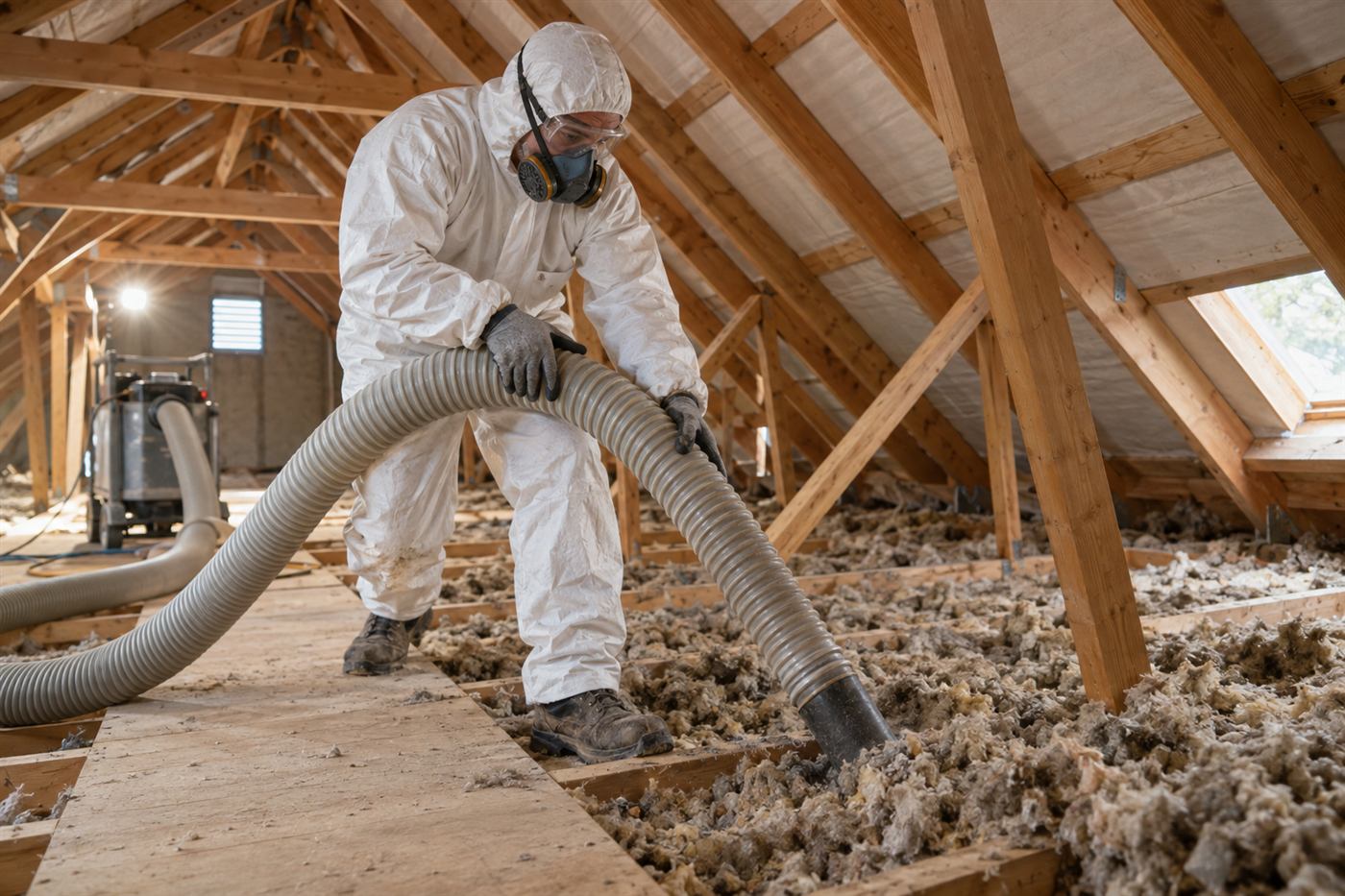
Removal itself generally uses a vacuum system with a long hose, which in a building may run up a stairwell, through a service route or from a vehicle at the curb, depending on what the building allows. The crew should protect floors, doors and elevators on the route, and keep the debris contained and bagged. Afterward the space is cleaned and made ready for new material.
- Confirm who controls the space and whether approval is needed.
- Have the contractor inspect and document the area, including the cause of damage.
- Fix the source of moisture or pests, if that is not already done.
- Schedule removal in line with building hours and neighbor notice.
- Seal air leaks in the cleared space, then install the new material.
- Walk through the finished work and keep the documentation for the association file.
Choosing replacement material for a humid coastal building
The new insulation should match the space. In an attic with open joists, blown-in fiberglass or cellulose is common. In tight spaces or where air movement is the main concern, spray foam may be considered, though a building may have rules about it, and ventilation and fire-related questions should be settled first. Our page on spray foam in Hallandale Beach lays out how those conversations usually go, and attic insulation in Hallandale Beach covers the more common open-attic jobs.
In coastal air, moisture behavior matters as much as thermal performance. Materials that stay stable when humid, and installation that leaves airflow paths such as soffit vents unblocked, tend to last longer. Poor ventilation is one of the reasons insulation fails in the first place, so a good job addresses it rather than ignoring it.
Quotes are given by phone. For simple, clear jobs we can often discuss the details by description. For complex work, including anything in a shared space, an on-site visit is needed first, and a service call charge applies for that visit. It is explained on the phone before dispatch.
Planning a building-wide or phased project
When several units show the same symptoms, treating them one at a time can be wasteful. A board that hears complaints from three top-floor owners about heat and stains may do better to commission one inspection of the entire roof space and decide from there. A single survey shows how far the damage runs, whether the cause is a roof membrane, a drain, a vent stack or a failed seal, and which sections of material can stay.
For larger buildings, phasing is common. The crew might start with the worst-affected section, finish it and then move on, which keeps the disruption to a manageable level and lets the board review the results before committing to the next stage. Good records help: photos before and after, a sketch of which areas were done, the type and depth of the new material and notes about anything unusual that was found.
Residents should be told what to expect. A short notice that explains the dates, the hours, what the crew will be doing and who to call with questions avoids most complaints. Management should also confirm that elevators, stairwells and parking areas used by the crew are protected and cleaned afterward. These details are not glamorous, but they are what separates a smooth project from a frustrating one.
Rental units, landlords and tenant concerns
If you own a unit that you rent out, removal work involves your tenant too. Give proper notice, explain what will happen, and agree on access times. Tenants often worry about dust, air quality and noise, and a short, clear explanation goes a long way. Ask the contractor to confirm the containment steps so you can pass them along.
If you are a tenant who notices a ceiling stain or a smell, report it to your landlord or property manager in writing and keep a copy. Do not open ceiling panels or climb into an attic space yourself. If you see active dripping near light fixtures or outlets, stay clear and tell the landlord right away, since water near wiring is a safety issue that needs attention before anything else.
If anything involves a possible gas, smoke or electrical hazard, call 911 or the utility first. Insulation work can wait. Safety cannot.
Getting started with a call
The best first step is a short phone conversation. Tell us whether you live in a tower, a low-rise or a townhome, which floor you are on, what you are seeing and hearing, and whether the building has any rules you already know about. Mention if you have talked to management and whether the area is a unit or common element.
Have photos ready if you can take them safely from an access panel without stepping inside. Note the age of the building if you know it, any known roof or plumbing leaks, and any past work that disturbed the attic or ceiling. That information helps us tell you whether removal looks necessary, what the visit would involve and what to arrange with your association.
When you are ready, call Boca Raton Insulation and we will talk through the options for your Hallandale Beach building, in plain language and without pressure.
Questions people ask
Can I remove or replace insulation in my condo myself, or do I need approval?
Most associations require approval for work that touches walls, ceilings or common areas, and many control the attic or roof space entirely. Check your governing documents or ask management before anything is scheduled. Doing it yourself is not advised, since old material and attic conditions carry health and safety risks that a trained crew is equipped to handle.
Who pays when damaged insulation is in a common area of the building?
That depends on your association's governing documents. Common elements such as roof spaces are usually the association's responsibility, while items inside your unit are often yours. Ask management or your board, and put the request in writing. A contractor can document the condition so your report is clear and specific.
Will the work disturb my neighbors?
It can, since sound and vibration travel through shared structures. Most buildings restrict work to certain hours, and good planning includes telling neighbors ahead of time and keeping the work as short as practical. Ask the contractor how they limit noise, and follow whatever rules your association sets for contractors.
Can new insulation fix noise from the unit above or beside me?
Sometimes it helps, but not always. Sound passes through structure, ducts, pipes and gaps, not only through insulation. Replacing damaged material may improve things in certain assemblies. A technician can look at your situation and give a realistic view of what is likely to help before you commit to anything.
What should I do first if I see a ceiling stain?
Photograph it, note whether it changes after rain, and report it to your landlord or association in writing. Keep away from any dripping near light fixtures or outlets. Finding and stopping the water source comes first. Removal and replacement of damaged insulation follows once the source is repaired and the area is dry.
How is pricing handled for a condo job?
Quotes are given by phone only. Simple jobs can often be discussed from your description, while more complicated or shared-space work needs an on-site visit first. A service call charge applies for that visit and is explained on the phone before anyone is dispatched. Call us with your building details and we will go over the next step.
Describe the situation by phone and we will tell you what the job involves. Quotes are given by phone. Jobs that cannot be quoted without seeing them need a technician on site, and the service call charge is explained on the phone before anyone is dispatched.
(561) 854-1888Related pages
Removal Work for Hallandale Beach Homes and Condos
Hallandale Beach has a mix of older low rise buildings, townhomes, and single family houses, and each one raises different questions for a removal and replacement job. In a condo or townhome, the first step is often reading the association rules about work hours, elevator use, and debris handling. The crew will ask you about those rules at the start so nothing is a surprise on the day. For a single family home, the conversation shifts toward the attic, the roof deck, and any past leaks. The scope and any quote are always explained before work begins, so you know what is being removed and why.
Salt air and constant humidity shape what the crew looks for once the old material is exposed. Metal fasteners, duct straps, and exposed wiring can show corrosion in coastal areas, and that is worth pointing out so you can have it addressed. Insulation that has absorbed moisture over many hurricane seasons may smell musty, clump together, or show dark staining on the decking above it. The crew photographs what they find when it helps, and talks through whether the problem is old, ongoing, or worth a roofer or other trade taking a look before new material is installed. Ask questions anytime during the visit.
Cleanup matters as much as the installation in a tight building. Old material is bagged or hosed out into a contained system, walkways are protected, and the work area is vacuumed before the crew leaves. Replacement material goes in only after the space is sealed at the gaps that were found, so air does not slip around the new layer. You can help by clearing the attic access, moving parked vehicles if the crew needs the space, and telling neighbors about the work if shared hallways or parking are involved. If the building has shared systems, the crew works around them carefully and tells you if anything needs the manager's attention before they continue.