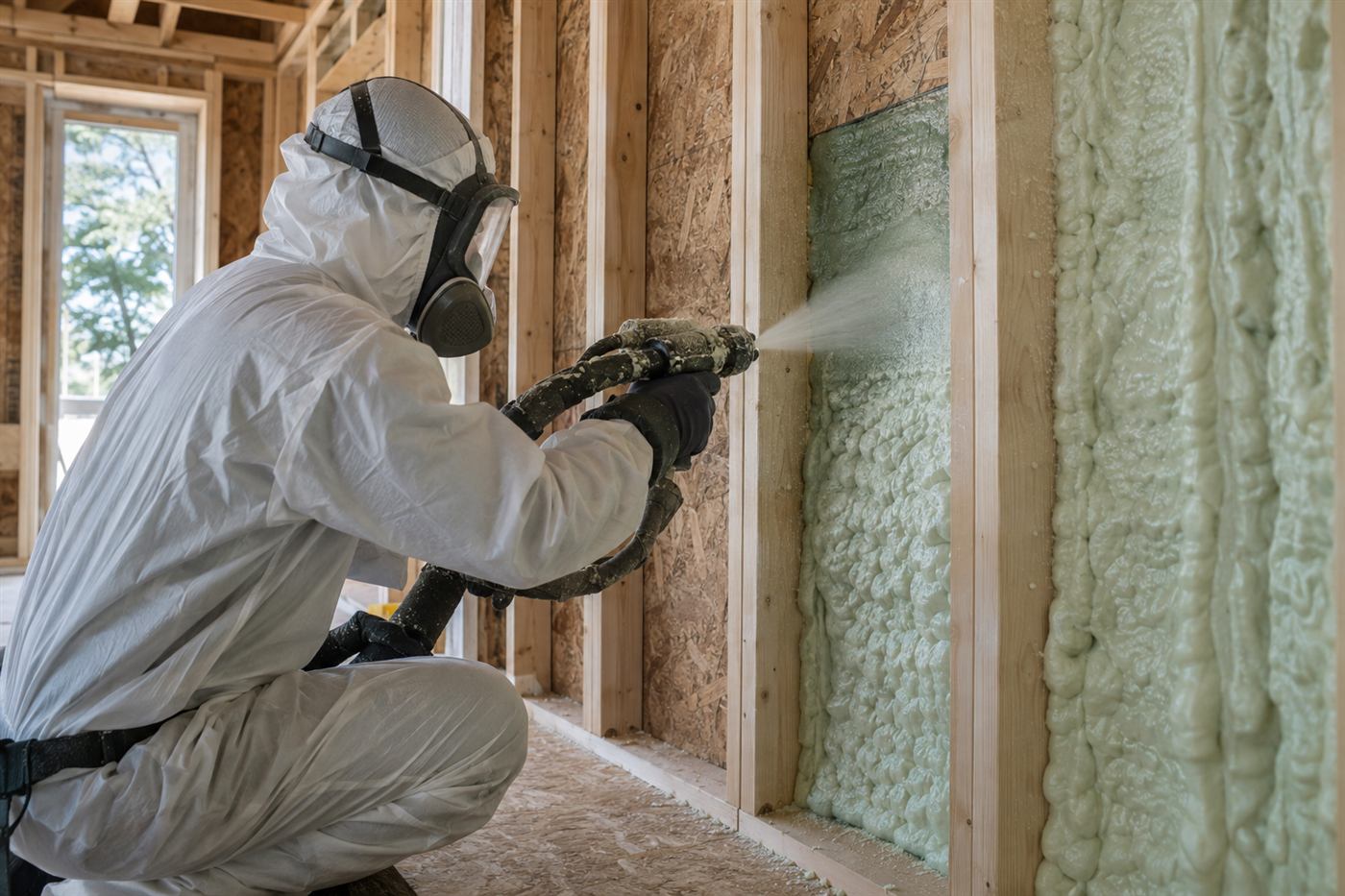
What roof deck foam actually is
Spray foam insulation is a two-part liquid that is mixed at the spray gun and expands as it cures, sticking to whatever it lands on. Applied to the underside of a roof deck, it forms a continuous layer that insulates and seals the attic from the roof side rather than from the ceiling below. The result is an attic that sits closer to the temperature of the living space, with the roof deck itself separated from the heat on the other side.
That is different from the traditional approach of laying insulation on the attic floor. With a floor layer, the attic stays hot and vented, and the ducts and air handler live in that heat. With foam at the roof deck, the attic is brought inside the building envelope, and any equipment up there sits in a milder space. Some owners like this because it protects ducts and the air handler from extreme attic temperatures.
It is not automatically the right choice. Foam is a more involved installation than blown-in or batts, it changes how the roof assembly behaves, and it must be chosen with the building in mind. This page walks through how that decision looks in Aventura, where building types, salt air and association rules shape the answer.
Which Aventura buildings can use roof deck foam
Many of Aventura's residents live in high-rise condominiums, and those towers generally do not have an attic above each unit. Their roofs are flat, often a built-up or membrane system with insulation placed according to the building's design, and owners of individual units do not control it. A resident of the twentieth floor will not be choosing roof deck foam for their apartment.
Foam does come into play for other property types: townhomes with pitched roofs, older low-rise buildings with attic spaces, villas and small multi-family buildings, and commercial or association-managed structures such as clubhouses, parking-level storage rooms and maintenance buildings. Top-floor units under pitched roof sections may also have attic space above the ceiling that the owner or association can address.
If you live in a condominium, the first question is who owns and controls the space above you. Many associations own the roof and everything above the ceiling slab, and any work there must go through the board. A technician can describe what the work would be, but the approval path is yours to confirm with your management office.
Salt air, humidity and the Intracoastal setting
Aventura sits next to the water, and salt air affects metal, fasteners and electrical components throughout the area. Roof decks in this environment can have corroded nails, rusted ductwork hangers and dampness in the wood from years of humid air moving through vented attics. Salt-laden air that enters through soffit vents is one reason older buildings can show rust in attics.
Closed-cell foam, which is dense and resistant to moisture movement, is often considered for coastal conditions because it blocks water vapor and air. Open-cell foam is lighter and lets more vapor pass, which affects how the roof deck dries if it gets wet. The choice is not about which is better in general, but about which behavior suits the roof assembly, the building and the owner's priorities.
Before foam covers a roof deck, a technician needs to look at the condition of the deck itself. If the plywood is soft, stained or corroded at the fasteners, foam can hide a problem that should be repaired first. Spraying over damaged decking is a decision that should be made deliberately, with a roofer involved if needed.
Condo association rules and approvals
In a community like Aventura, exterior and structural changes usually need association approval. Even interior-facing attic work may involve the board because the roof is a shared component. Boards often want to see a written scope, proof of insurance for the contractor, a description of materials, a work schedule and plans for protecting common areas.
Some associations have rules about working hours, elevator use for material and equipment, noise and odor, and notice to neighbors. Spray foam has a short period of odor during application and curing, and neighbors in attached buildings may want warning. Ask your management office about these rules before booking a visit, and ask the technician to describe the work in terms the board can review.
Insurers and lenders can also care about changes to the roof assembly. Mention the project to your insurance agent in advance if the roof is part of the covered structure. Nothing here replaces the board's own process; it is simply a list of questions that tend to come up.
Roof coverings, ventilation and permits
Converting a vented attic to an unvented, foam-insulated one changes how the roof deck sees heat and moisture. Soffit and ridge vents are typically sealed, and the roof surface can run warmer in summer because heat is not carried away by airflow underneath. Whether this matters depends on the roof covering. Tile, metal and shingle roofs behave differently, and the manufacturer of your roofing material may have guidance on foam below the deck. Check your roofing paperwork or ask the roofer before deciding.
In Florida, roof assemblies are heavily regulated, especially for wind resistance. Foam applied at the underside of the deck is sometimes treated as an insulation scope and sometimes triggers questions about the roof's wind-load details, particularly if foam is also used to hold roofing components in place. Permit requirements depend on the city and the scope. The permits for insulation work guide gives the general picture, and your building department has the final say.
Fire safety also comes into play. Some foams require an approved thermal barrier or ignition barrier where exposed in occupied or accessible attic spaces. A technician should be able to explain what applies to your building and what the foam product's technical documents say. If those details are vague, keep asking until they are clear.
Open-cell versus closed-cell in plain terms
Open-cell foam is soft, light and spongy, and it expands to many times its liquid volume. It insulates well and air seals, and it lets water vapor pass through, which can help the roof deck dry out. It is generally not meant to be in contact with liquid water for long periods. Closed-cell foam is denser and harder, resists water and vapor and adds some stiffness to what it covers. It tends to be used where moisture resistance matters or where a thinner layer must do more work.
In the humid, warm climate here, the decision usually comes down to the roof system, the budget, the building's age and what an owner wants out of the attic. Neither type is a cure-all. Either one can fail to perform if the surface was dirty, wet or poorly prepared, or if the installer applied it too thick in one pass.
The article spray foam versus blown-in compares the approaches for readers who are still deciding whether foam makes sense at all, and spray foam insulation describes the service in general terms.
Preparation, safety and re-entry
Spray foam installation involves chemicals that need proper protective equipment and ventilation during application. Occupants are usually asked to stay out of the building, or at least away from the work area, during spraying and for a period afterward while it cures. The technician or installer should explain the manufacturer's re-entry instructions, and you should follow them. Do not enter an attic during or soon after application.
Preparing the property typically means clearing attic storage, protecting items below, covering windows or AC returns that could draw fumes and arranging for pets to be elsewhere. Roofs and soffit vents may need to be sealed or masked. If the building is occupied by tenants, the owner should coordinate notice.
It is worth remembering that foam is not something an owner should try to apply with a hardware store kit across an attic. The equipment, ratios, temperatures and lift thickness need to be right, and mistakes are costly. Leave it to trained installers, and do not use any attic space as a living area until the manufacturer's cure time is reached and the installer confirms it is safe.
What a technician checks on the visit
Because a foam project changes the building, quotes come only after an on-site visit, and the price is given by phone afterward. There is a service call charge, which is explained before dispatch. The visit is about whether foam suits the building and how it would be done.
Items usually reviewed:
- The roof structure: pitch, decking type, condition and the presence of leaks or stains.
- Existing insulation on the attic floor and whether it would stay or be removed.
- Where ducts and the air handler sit and whether they would be inside the conditioned space.
- How the attic is vented now, and what changes if vents are sealed.
- Fire and ignition barrier needs given how the attic is used.
- Access for hoses and equipment, and where the rig can stand.
- Association or management rules that apply to this particular building.
Cases where foam is not the right answer
Sometimes the honest recommendation is not foam. A roof that is near the end of its life may need replacing first, since foam under a failing roof traps problems. A building with a leaking roof should have the leak fixed and the damaged material removed before anything is sprayed. An owner who simply wants a cooler top-floor ceiling may do better with air sealing and added blown-in insulation, which costs less labor and is easier to undo.
A condominium owner who does not control the roof cannot choose foam on their own. A building with an unusual roof assembly, such as a flat roof with a hidden drainage layer, may need a design professional rather than a spray crew. And some owners prefer to keep an attic vented because they plan major roof work soon.
A good contractor will say so when foam is a poor fit. If you hear only that foam is the answer to every problem, ask why the alternatives were ruled out. The insulation for condos guide explains how ownership of ceilings, roofs and walls affects what you can do.
Air sealing, ducts and the comfort payoff
Most of what owners feel after foam goes in comes from air sealing rather than from the insulating number on the label. In an ordinary vented attic, conditioned air leaks upward through gaps around wiring, plumbing chases, recessed lights and the tops of interior walls, while hot attic air presses down through the same openings. Foam at the roof deck stops the attic from being a hot, leaky buffer by changing where the boundary of the building sits.
If the ducts and air handler are in that attic, the effect can be noticeable. Ducts that once ran through air that reached extreme temperatures now run through a much milder space, so they lose less cooling on the way to the rooms. Rooms at the end of a long duct run often improve the most. That said, a leaky or undersized duct system will still be leaky afterward, and the air sealing page explains why sealing and insulation work best as a pair.
Humidity control matters too. When an attic is closed off and conditioned, it is important that the air conditioning system and any intentional return path are sized and balanced for it. Sealing an attic that had been leaking air into the living space can change how the house breathes. A technician should talk through whether the air conditioning company needs to be told, and whether bathroom and kitchen exhaust paths are correct before work starts.
A few Aventura scenarios
A townhome owner near the water has a second-floor bedroom that never cools. The air handler sits in a hot attic with long ducts. After a visit, the technician notes decent roof decking and an association that allows the work, and foam at the roof deck is quoted as one option alongside sealing and a new layer of blown-in.
A low-rise building's board is considering the clubhouse and storage rooms. The roof is a flat membrane, so the plan involves walls and a different approach entirely. The visit becomes a conversation about scope rather than a spray appointment.
A retired owner in an older villa has rusty nail points showing through the roof deck in the attic. The advice is to have a roofer look first, because foam over corroded fasteners hides a problem. These stories show that the first step is understanding the building, not choosing a product.
Questions to bring to the first call
Owners get the most from a first conversation when they bring facts rather than assumptions. Know whether you own the roof or the association does. Know roughly how old the roof is and whether it has leaked. Know where the air conditioning air handler sits and whether there are ducts in the attic. Know whether the building is a townhome, a low-rise or a villa.
Then ask how the technician would approach a building like yours, what could make foam a poor fit and what the alternatives are. A frank answer includes situations where foam would be skipped. If the conversation is only about product, ask to talk about the building.
Call to talk it through
If you are weighing roof deck foam in Aventura, start with three facts: who owns the roof, how old the roof is and where your air handler sits. Add any photos of the attic or notes about past leaks. A phone conversation can sort out whether a visit makes sense.
Read the Aventura insulation overview for more about local building types, then call. Quotes are given by phone, a service call charge is explained before dispatch, and the visit is where the building is actually assessed.
Questions people ask
Can I have roof deck foam in a high-rise condo unit?
Generally no. Tower units usually do not have their own attic, and the roof belongs to the association. Foam is more relevant to townhomes, low-rise buildings with pitched roofs, villas and some commercial structures. If you are in a high-rise, the better questions are about unit walls, ceilings and sound, which a technician can discuss by phone.
Does salt air affect whether foam is a good idea?
It affects what you find in the attic: rusted fasteners, corroded hangers and damp wood. Foam can seal out salt-laden air once applied, but it should not be sprayed over damaged decking or corroded parts that need repair. A technician checks the roof deck condition during the visit and may recommend a roofer first.
Do I need association approval for attic foam?
In most Aventura communities, yes if the roof is a common element or if the work touches shared structure. Associations often ask for a written scope, insurance proof and a schedule. Ask the management office early. A technician can describe the work in writing, but approval comes from your board, not from the contractor.
How long before I can go back into the building?
Follow the product manufacturer's re-entry and cure instructions, which the installer should explain before spraying. Occupants are normally kept out of the work area during application and for a period afterward. Do not enter the attic until the installer confirms it is safe. If anyone has respiratory concerns, mention it when you call.
Is foam better than blown-in insulation?
Neither is better in every case. Foam seals air and can bring ducts into conditioned space, but it is more involved, affects the roof assembly and often requires permit review. Blown-in on the attic floor is simpler and easier to change. The right choice depends on the roof, the building and your goals.
Will foam change how my roof is treated by insurers or roofers?
It can. Roofers and insurers sometimes have views about foam under a roof deck, especially on older roofs or specific coverings. Check your roofing paperwork and ask your insurance agent before committing. A technician can supply product information, but the final word on roof matters rests with your roofer, insurer and building department.
Describe the situation by phone and we will tell you what the job involves. Quotes are given by phone. Jobs that cannot be quoted without seeing them need a technician on site, and the service call charge is explained on the phone before anyone is dispatched.
(561) 854-1888