The plain meaning of R-value
R stands for resistance, and the number tells you how strongly a material resists the flow of heat. A higher R-value means heat moves through it more slowly. If you think of heat as water trying to get through a filter, R-value is how fine the filter is. Doubling the thickness of the same material doubles the R-value, so a layer twice as deep resists about twice as much.
The measure comes from laboratory tests on small samples under controlled conditions. In the test, a slab of material sits between a warm plate and a cool plate, and equipment measures how much heat passes through in a set time. The result is reported as R per inch or as a total for the thickness tested. The conditions are steady, dry and without any air leaks, which is not how a real attic behaves.
That is not a flaw in the number. It is a fair way to compare materials to each other. But it means the label tells you about the material, and says little about the installed assembly. The difference between those two things is the main point of this page.
Where R-value matters most in South Florida
In a cold climate, insulation keeps heat inside during long winters. Here the job is nearly reversed. The sun heats the roof and the air, and the air conditioner works to remove that heat from the house. Insulation slows the heat coming in through the ceiling and walls, which cuts the load on the cooling system.
The ceiling is where most of it happens. A dark roof can reach very high temperatures in afternoon sun, and the attic below it can be much hotter than the outdoor air. That heat flows down through the ceiling into the rooms, and a higher R-value on the attic floor slows it. That is why attic insulation is the usual place to start.
Walls matter too, but in a typical house, walls receive less direct sun than the roof and the temperature difference across them is smaller. For that reason, national guidance recommends higher R-values for attics than for walls. The page on how much attic insulation you need gives the range of recommendations for the hottest climate zones.
R-value per inch for common materials
Different materials resist heat to different degrees. The numbers below are typical estimates and vary by product, density and how the material is installed. They are useful for comparing, not for promising an exact result.
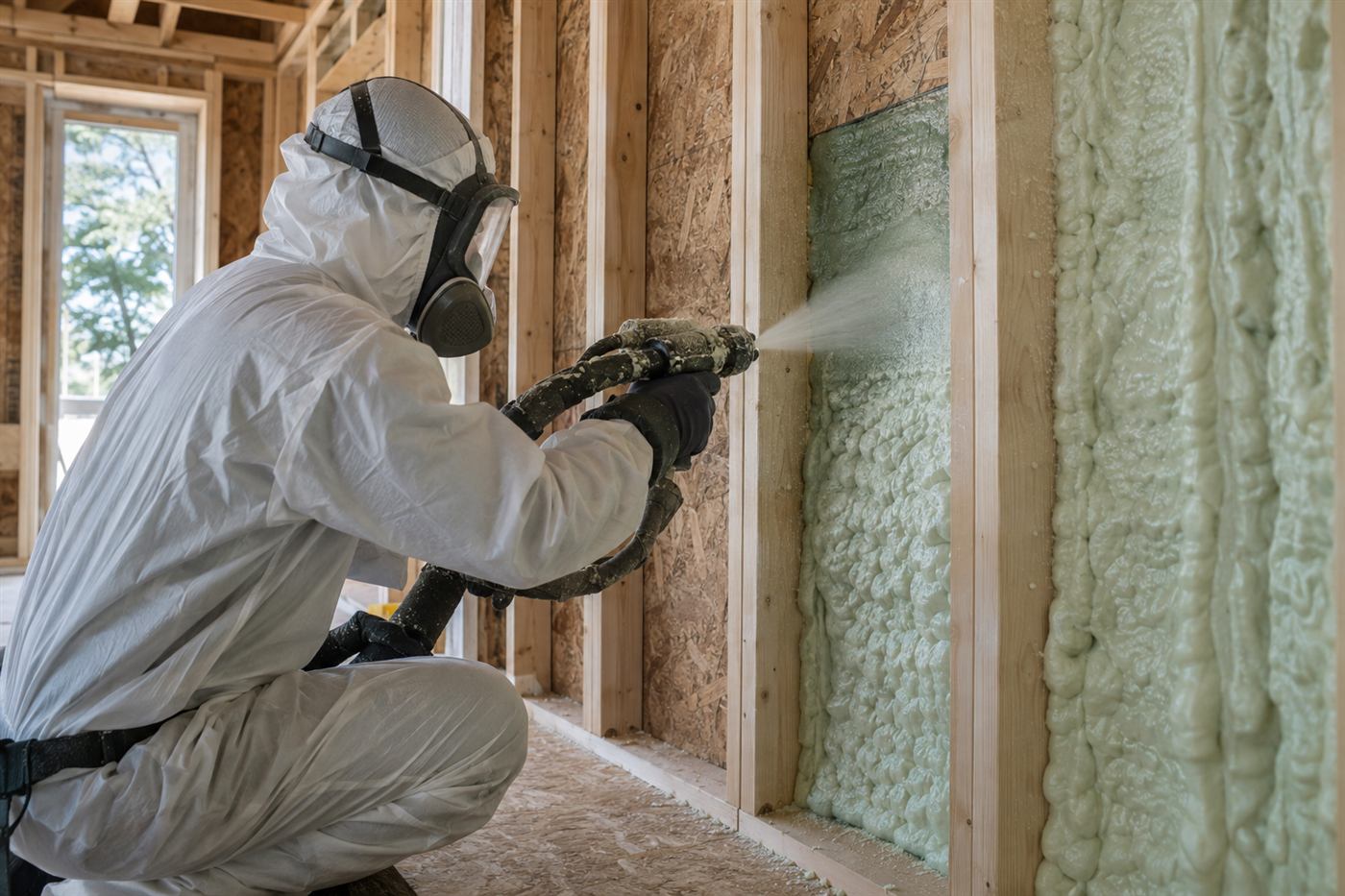
Loose-fill fiberglass and rock wool are a little over two per inch, cellulose is about three and a half, open-cell spray foam is a little under four, and closed-cell foam is around six or more. Fiberglass batts range with their thickness and density. Rigid foam boards range from about four to over six per inch, depending on the type.
| Material | Approximate R per inch | Notes |
|---|---|---|
| Loose-fill fiberglass | A little over 2 | Settles over time, easy to add to |
| Cellulose | About 3.5 | Denser, absorbs water more readily |
| Open-cell spray foam | A little under 4 | Soft, vapor-open, air seals |
| Closed-cell spray foam | Around 6 or more | Rigid, water resistant, air seals |
| Rigid foam board | About 4 to over 6 | Depends on foam type |
Why the label is not the whole story
A tested R-value assumes that the material is installed at its rated thickness, evenly, with no gaps, dry, and with no air moving through or around it. Real attics rarely meet all of those conditions. Each departure from them lowers the performance you get below the number on the bag.
Think of a wool coat with a hole in it. The coat may be rated very warm, but if wind comes through the hole, it feels cold. In a house, the wind is air movement, the hole is any gap in the ceiling, and the coat is the insulation on top. A high rating on the material does not make up for air leaks that let heat and humidity bypass it.
Installers and building scientists talk about the difference between rated R-value and installed or effective R-value. The effective value is what the assembly actually delivers once you account for gaps, compression, thermal bridging through framing and air leakage. It is usually lower than the label, sometimes by a lot.
Gaps, voids and compression
Insulation works by trapping still air. If a batt is squeezed into a cavity that is too small, or flattened by a heavy item stored on top, the air pockets collapse and the R-value falls. If there are voids, such as an uninsulated spot behind a wire or at the end of a joist bay, heat flows through the gap at full rate.
These gaps can be surprisingly influential. A small bare patch can carry more heat than its size suggests, because heat favors the easiest path. In a ceiling, a few uncovered areas can offset the benefit of a thick layer elsewhere. That is why good installers pay attention to edges, corners and obstacles as much as to the open middle.
Loose-fill can have the same problem on a smaller scale. A path trampled flat to reach equipment, a pile pushed aside by a repair or a thin area near the eaves all lower performance. A uniform blanket is worth more than a thick pile in the middle and nothing at the edges.
Air leaks and moisture
Air movement is the most common reason installed performance falls short. Air that passes through or around insulation carries heat with it, and in this climate carries humidity as well. A leaky ceiling can let warm attic air flow into the living space through top plates, penetrations and recessed lights. The insulation sits on top of those leaks, doing less than its rating suggests.
That is why air sealing comes first. Closing gaps lets the insulation do the job it was designed for. The page on air sealing explains the usual sequence and why the order matters.
Moisture matters because water conducts heat far better than air. Wet insulation loses much of its resistance until it dries, and in some materials the loss is permanent. A leak, a sweating duct or humid air condensing in the attic can quietly reduce the effective R-value of the layer above it. The page on moisture in attic insulation covers how to spot it.
Thermal bridging and the role of framing
Heat does not only travel through the insulation. It also travels through the framing, which is wood or metal. In a wall with insulation between studs, the studs themselves conduct heat at a different rate, and the heat takes the easiest path through them. This is called thermal bridging. The effective R-value of the whole wall is lower than the R-value of the insulation between studs.
In an attic, the ceiling joists act as bridges too. Insulation that is only as deep as the joists leaves the tops of the joists as paths for heat. Adding a layer that covers the joists reduces that bridging, which is one reason a deep layer works better than one level with the joists.
Metal framing bridges more strongly than wood. In commercial and metal-building construction, bridging is a major concern and is addressed with thermal breaks and continuous layers. The page on commercial metal building insulation describes that situation.
Radiant heat and why R-value misses part of the picture
R-value is measured under conditions that mostly capture conduction, heat passing through a material. In a South Florida attic, a large share of the heat arrives by radiation, energy traveling in waves from the hot roof deck to the cooler surfaces below. A radiant barrier, a reflective surface, works against that, and R-value does not describe it well.
That does not mean R-value is wrong, only that it describes one thing. A well-designed attic combines insulation to slow conduction, air sealing to stop movement and, in some cases, a reflective layer to cut radiant gain. The page on radiant barrier explains where that fits and where it does not.
Be cautious of any claim that a single product has a very high effective R-value because of reflective properties. Reflective layers do something real, but the label rating and the effect on a hot attic are not directly comparable.
A simple picture: layers, paths and the weakest link
It helps to picture heat as taking every available path from the hot side to the cool side at once. Some paths are through deep insulation, where it travels slowly. Some are through thin spots, bare drywall, framing and gaps, where it travels quickly. The total flow is the sum of all paths, and the fast ones dominate.
That is why the weakest areas matter so much. If ninety parts of a ceiling are heavily insulated and ten parts are bare, the bare parts can account for a large share of the heat that gets through. Raising the R-value of the already thick area does little. Covering the bare area does a lot. This is the logic behind a careful visual check of the whole attic before any material is added.
The same picture explains why an overall average is only part of the story. When a technician measures depth in many places, they are looking for the low spots, not just the average. They want to know where heat is likely to take the shortcut.
Common misunderstandings
One misunderstanding is that R-value measures how much money you will save. It does not. It measures resistance to heat flow. How much energy that saves depends on the house, the climate, the air conditioner, how the home is used and many other factors. No site, including this one, can promise a particular saving from a particular number.
Another is that R-values simply add up across any layers. They do add for layers in sequence in the same heat path, but not across gaps or mixed assemblies, and moisture or compression can change the result. A third is that R-value is the same in all conditions. Most materials perform best when dry and at moderate temperatures, and the lab figure is for those conditions.
A fourth is that higher R-value means thicker. Some materials, such as foam, give more resistance per inch, so a thin layer can match a deep one of a different material. And a fifth is that R-value is the only number that matters. Air leakage, moisture control, ventilation and fire safety are all part of a good insulation plan, and none of them appears on the R-value label.
Checking installed performance in your own home
You can learn a lot without any fancy tools. Check the depth of the attic insulation in several places and compare it to the target range. Look for bare patches, compressed paths, wet spots and blocked soffit vents. Feel the ceilings on a hot afternoon: warm patches suggest thin or missing material above.
Technicians use extra tools on a visit. A thermal camera shows where surfaces are warmer or cooler than they should be, which reveals voids and air leaks that the eye cannot see. A blower door test pressurizes or depressurizes the house to measure how leaky it is overall and to help find the leaks. A moisture meter shows hidden dampness.
These checks turn the label number into a picture of how the assembly behaves. They are most useful on houses where the owner has done what seems like the right thing, such as adding a thick layer of insulation, and the house still does not feel right. In those cases the answer is usually in the gaps. The page on energy audits describes how a more thorough inspection works.
How to use R-value when comparing proposals
Use R-value to compare materials and to set a target, and then look at what supports it. Ask what depth of material is proposed and how it translates to total R-value. Ask what will be done about air leaks before insulation goes in. Ask about the eaves, the hatch, ducts and recessed lights. Ask whether existing material will be kept and in what condition.
Be skeptical of proposals that quote a single large number with no detail. A high R-value on paper means little if the work includes no preparation. Equally, a modest R-value with good air sealing and even coverage can outperform a high number applied over leaks.
Look for plain explanations. A good technician can describe what the number means in your attic, how it was measured and what could cause the result to fall short. Quotes here are given only by phone, and complicated jobs need an on-site visit. Call the number on this page to talk through your own numbers.
Before you call, write down what you know: the depth you measured, the material if you can tell, roughly when the insulation was installed, and which rooms run hot. If you have photographs of the attic, keep them handy. With those details a technician can tell you in plain terms whether your current numbers are likely to be adequate, where the weak points probably are and whether a visit is the next sensible step. That short conversation often clears up more confusion about R-value than any amount of reading.
Questions people ask
What does R-value stand for?
R stands for resistance to heat flow. A higher number means the material resists heat more strongly at a given thickness. It is measured in a laboratory and used to compare materials. It describes the material, while real performance also depends on how it is installed and what is around it.
Is a higher R-value always better?
More resistance generally helps, but gains get smaller as the number rises, and the installation matters as much as the number. Gaps, compression, air leaks and moisture all reduce performance. Sealing and even coverage often do more than adding another layer on top of a leaky ceiling.
Why is my attic still hot with a high R-value?
Attics in this climate get extremely hot, and insulation slows the heat entering the living space but does not cool the attic. Leaks, thin spots, duct losses and radiant heat can still make rooms warm. A visit can show which of these applies to your house.
Does R-value change over time?
It can. Loose-fill settles, moisture lowers performance until material dries, and pests or disturbance create gaps. Some foam products age slightly as gases leave the cells. Dry, undisturbed insulation can perform well for many years, but it is worth checking an older attic every so often.
Do walls need the same R-value as the attic?
No. Guidance generally calls for higher values in attics than in walls, because the roof takes the strongest sun and the temperature difference across the ceiling is larger. Walls still matter, particularly in older block homes with little insulation, and the right approach differs by construction.
How do I get a quote?
Quotes are given by phone after you describe your home, and complicated jobs need an on-site visit first. A service call charge applies and is explained on the phone before dispatch. Photos of the attic and any depth measurements you have taken help the conversation.
Describe the situation by phone and we will tell you what the job involves. Quotes are given by phone. Jobs that cannot be quoted without seeing them need a technician on site, and the service call charge is explained on the phone before anyone is dispatched.
(561) 854-1888