What blown-in insulation actually is
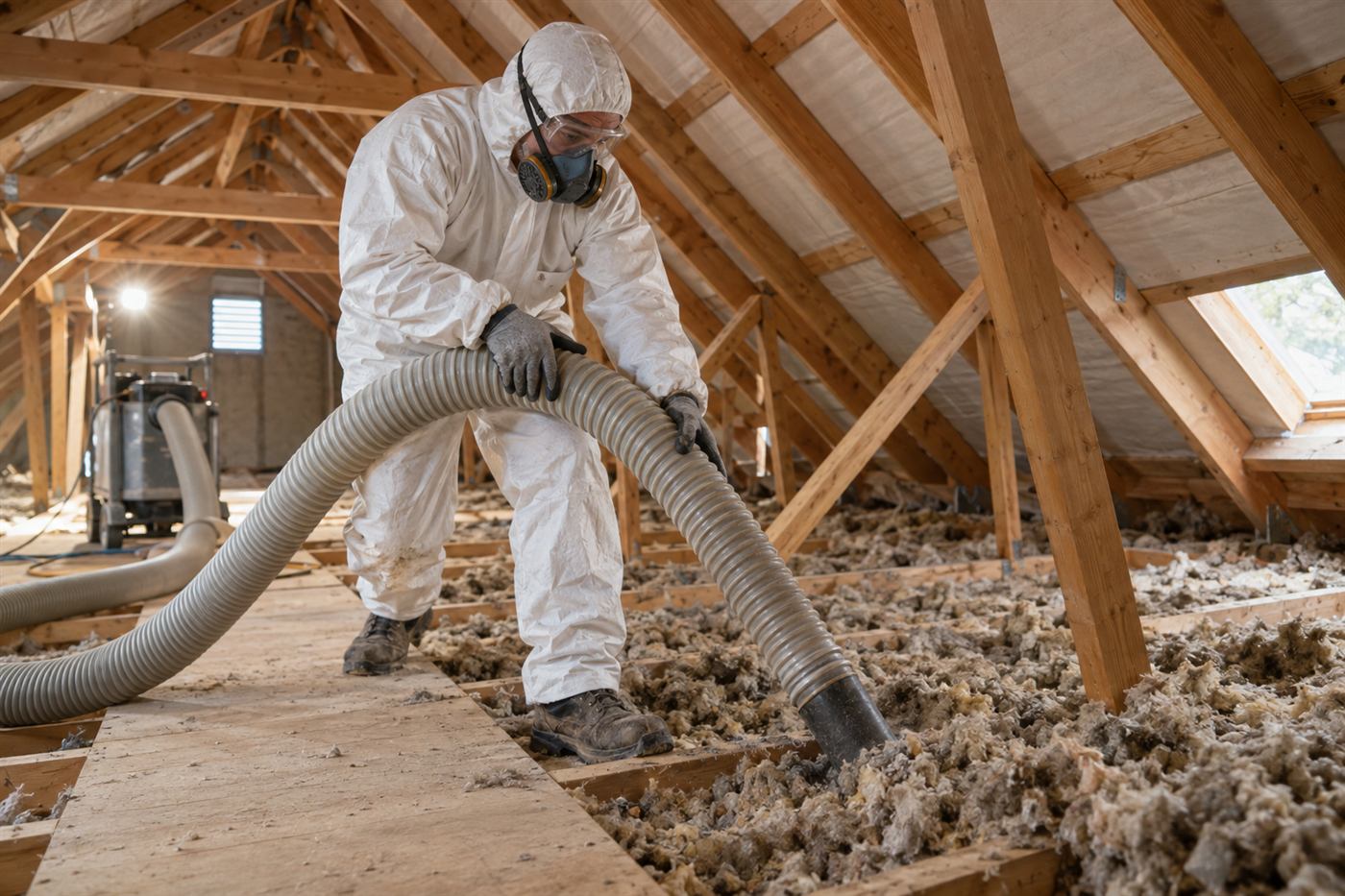
Blown-in insulation, also called loose-fill, is made of small pieces of fiberglass, mineral wool or cellulose that are fed into a machine and pushed through a long hose. The machine breaks the material up into a fluffy mass that settles into the space being filled. In an open attic the crew lays it over the ceiling in an even blanket. In a closed wall cavity it can be packed in at higher density through a small hole.
The big advantage is flow. Loose-fill finds its way around joists, bracing, wires, pipes and odd corners without cutting and fitting. That makes it a good match for attics that have lots of obstructions and for finished walls that cannot be opened up without damaging the drywall.
The tradeoff is that the result depends on the installer. Settled depth, uniformity and the care taken at the edges all depend on skill and attention. This page walks through how a blown-in job should go, so you can recognize good work and ask the right questions.
The materials: fiberglass, cellulose and mineral wool
Loose-fill comes in three common types. Fiberglass is made of glass fibers, is lightweight, does not hold water the way paper can and is common in Florida attics. It tends to be fluffy and covers a large area per bag. Cellulose is recycled paper treated with borate and other chemicals for fire and pest resistance. It is denser, packs well into cavities and helps slow air movement through the layer, but it can absorb moisture and can settle more over time.
Mineral wool loose-fill is made from rock or slag fibers. It is dense, fire resistant and does not absorb much water, though it is less widely available.
Which one fits depends on the space, the humidity exposure and your preferences. Many Florida installers favor fiberglass for attic floors, with cellulose used for wall cavities. Our comparison guide on fiberglass, cellulose and foam goes through the strengths and weak spots of each. When you receive a proposal, it should name the product, not just say blown-in insulation.
Preparation before a single bag is opened
Good installs start with preparation. The crew walks the attic, noting wiring, pipes, ducts, equipment and anything that needs to be protected. They check the condition of existing insulation and look for water stains, rodent evidence and open junction boxes.
Air sealing comes before insulating. Gaps at top plates, around vent stacks and beside recessed lights are closed so that the new layer is not covered by leaks. Next come baffles at the eaves to protect soffit airflow, dams around the hatch and flues, and covers for any unrated recessed fixtures. Our air sealing page explains this stage.
Junction boxes must remain accessible. Wire connections should not be buried in a way that hides them. Where required, boxes get a marker or an extension so that anyone working on them in the future can find them. Any exposed wiring that looks damaged should be reported to the homeowner, and an electrician involved if repairs are needed.
At the end of prep, depth markers go in. They are small rulers placed across the attic so that the final depth is easy to verify. If a crew skips them, ask why.
The machine, the hose and the blowing sequence
The equipment sits outside, usually near the truck, with a long hose carried through the attic hatch. One person feeds bags into the machine, and another carries the hose and directs the stream. Communication between the two is important, because the person in the attic cannot see the hopper.
The installer begins at the far end of the attic from the hatch and works back toward the opening, so that they never walk on finished insulation. The stream is swept in even passes, building depth gradually rather than dumping in one spot. At the eaves, the installer takes care to keep baffles clear and avoid pushing material over the top plate.
In walls, the process is different. A small hole is made in the drywall or through the exterior at each stud bay, and a fill tube is inserted. The material is blown in until the cavity is full and the machine senses resistance. The hole is then patched. Each bay needs its own access, and fire blocking inside the wall may require additional holes. Wall work is more technical than attic work and should be done with attention to the wall type, any existing material and moisture risks.
In both cases, the machine settings, the hose length and the installer's pacing affect density. Too light and the material will settle more. Too heavy and it can be wasteful or put weight on a ceiling.
Coverage, depth and how to check them
Every bag of insulation carries a coverage chart that shows how many square feet it will cover at a given depth. Installers use this to calculate how many bags to use for a given area and target performance level. The count should match the planned result. If a crew leaves a pile of unused bags, or runs out well before finishing, something is off.
Depth should be checked with the markers, and also by looking and feeling in several places: the center of the attic, the edges and the areas near the hatch. A level surface with a consistent, readable depth is what you want to see. A rolling landscape of mounds and shallow spots suggests uneven work.
The final result should include a note about the depth achieved and the type of material, and in many cases a card or label posted in the attic. Keep that record. It will help when you sell the home, when a future technician needs to know what is there, and when you check settling later.
If you want to understand what depth means for performance, the guide on how much attic insulation you need and our page on R-value explain the basics. Ask your technician for the target level that applies to your area and how close the job comes.
Settling: what it is and how installers plan for it
Loose-fill settles. Fibers compress under their own weight and over time, especially cellulose and lighter fiberglass. The settled depth is lower than the installed depth, and what matters for performance is the settled number. Professional installers account for settling by installing to a depth that, after settling, still meets the target.
You may see two numbers on a coverage chart: initial and settled. Ask which one the crew is using. Shortcuts here show up a year or two later, when an attic that looked fine at first has noticeably thinned.
Other factors speed settling. Vibration from foot traffic, wind-washing near the eaves, moisture and uneven installation can all compress the layer. Keeping people off the insulation, using walkway boards for access and protecting the edges with baffles help preserve depth.
If you suspect settling in an older attic, a technician can measure the depth in several places and tell you whether a top-up is needed. In many cases, adding new material over the old restores performance without removal.
Walls, dense-pack and finished homes
Many South Florida homes have walls that were never insulated or that were insulated lightly. Opening them is expensive and disruptive, so loose-fill is often the practical option. With dense-pack, the material is packed at a higher density to resist settling and slow air movement within the wall.
A technician will check the wall construction first. Concrete block with furring strips and interior drywall has cavities that are shallow and sometimes interrupted. Frame walls have deeper cavities but may have fire blocking, wiring and plumbing. The inspection may use a thermal camera or a small hole and borescope to look inside before deciding.
Dense-pack in a wall that has moisture problems is a bad idea. If a wall leaks or has been wet, the source must be fixed first, because insulation can hold water against the framing and hide further damage. Our guides on dense-pack wall insulation and insulation for concrete block homes go deeper on these points.
Once the cavities are filled, the holes are patched and sanded and the wall is ready for paint. A good crew leaves a clean surface, though paint matching is usually the homeowner's follow-up.
Common mistakes that spoil a blown-in job
Knowing what goes wrong helps you spot a careless job. The mistakes below show up often enough that they are worth asking about before you agree to any proposal.
A crew that rushes the preparation can bury air leaks, cover recessed lights without proper protection and leave soffit vents blocked. A crew that works without markers may end up with a layer that is thick near the hatch and thin at the far edges, simply because the hose reached those spots with less effort. A crew that does not account for settling leaves you with a depth that looks fine on installation day and falls short a year later.
- Skipping air sealing so that new insulation sits over open gaps.
- Missing baffles at the eaves, which lets material slide over the soffit vents.
- Covering junction boxes so that they cannot be found later.
- Pushing loose-fill against a flue pipe or an unrated light housing.
- Leaving thin spots at the edges of the attic and around the hatch.
- Walking on the finished layer and compressing it.
- Blowing over wet or contaminated old insulation without addressing it first.
- Using a different product than the one named in the proposal, without telling the owner.
A scenario: topping up an older block-home attic
Picture a single-story concrete block home with a shingle roof and a trussed attic. The owners moved in a few years ago, and the attic holds a thin layer of older fiberglass that has matted down. Cooling bills feel high and one bedroom at the end of the hall is always warm.
The technician finds dry, clean material with no pest signs, which means it can stay. There are open gaps around plumbing stacks and several recessed lights that are not rated for insulation contact. The soffit vents are open but have no baffles, and the hatch has no weatherstrip.
The plan is to seal the gaps, add covers or replace the unrated fixtures through an electrician, install baffles, add a dam around the hatch and then blow new material over the old to the planned depth. Markers go in first and are checked at the end. The warm bedroom is reassessed afterward, and the technician notes that if it stays warm, the duct serving it should be inspected next.
That is the kind of ordinary, sensible job loose-fill does well. It is not dramatic, but done carefully it removes several sources of heat and leaves a record the owners can use later.
Dust, safety and what the household should do
Blowing insulation creates fine particles. The crew wears protective clothing, eye protection and respirators, and they typically close off the work area, cover floors, and seal the hatch opening when not in use. Even so, you should plan to stay out of the way. Keep children and pets out of the work zone, and let the crew know if anyone in the home has breathing sensitivities.
Do not enter the attic during or right after the job. The fibers can settle on skin and be irritating, and walking on fresh loose-fill compresses it. If you need to see the result, look from the hatch with the technician.
Cellulose has its own cautions. It is treated for fire resistance, but it should still be kept clear of heat sources and recessed fixtures that are not rated for contact. Loose-fill should never be pushed up against a flue or a hot light housing without proper barriers.
Our guide on insulation safety and dust has more on this, and it is worth a read before the job day.
How the call works and what to have ready
When you call, tell us about the house: single or two story, block or frame, approximate age, and what you want insulated. Say what you have noticed, such as warm rooms or high cooling bills. Quotes are given by phone for simple jobs. For complicated work, such as finished walls or a mixed attic, an on-site visit is the right approach, and a service call charge applies that is explained on the phone before dispatch.
Before the day of work, clear a path to the attic hatch and the outside area where equipment will sit. Move stored items from the hatch area. Let the crew know about locked gates, pets or neighbors who may be affected by the truck.
Afterward, ask for the depth record and a quick walkthrough from the hatch. When you are ready to start, call and describe what you are seeing, and we will go from there.
Questions people ask
Is blown-in insulation better than batts?
It is better in some situations and not in others. Loose-fill flows around obstacles and fills irregular spaces, so it often wins in attics with lots of wiring and framing. Batts can be a neat choice in open, regular cavities. A technician can compare them for your house.
How do I know the depth is right?
Ask for depth markers placed before the work and read them with the technician afterward. Also look at several areas, not just the middle of the attic. The installer should name the product, the settled depth and the target level, and leave a record of what was installed.
Will it settle?
All loose-fill settles to some degree. Good installers plan for it by blowing to an initial depth that will still meet the target after settling. Walkway boards, baffles and keeping foot traffic off the layer help it hold its depth.
Can walls be done without tearing them open?
Often yes. Small holes are made in each stud bay, the cavity is filled with loose-fill at dense-pack levels, and the holes are patched. The wall must be dry and in sound condition first, and a technician should check what is inside before deciding.
Is the dust a health concern?
Fine fibers can irritate skin, eyes and lungs, which is why crews wear protective gear and control the work area. Stay out of the attic and the work zone, and tell the crew about any breathing sensitivities. A cleanup at the end should leave living areas tidy.
How do I get a quote?
Quotes are given by phone for straightforward jobs. A more complicated house needs an on-site visit, and a service call charge applies that is explained on the phone before anyone is dispatched. Call and describe your home, and we will help you decide which route fits.
Describe the situation by phone and we will tell you what the job involves. Quotes are given by phone. Jobs that cannot be quoted without seeing them need a technician on site, and the service call charge is explained on the phone before anyone is dispatched.
(561) 854-1888