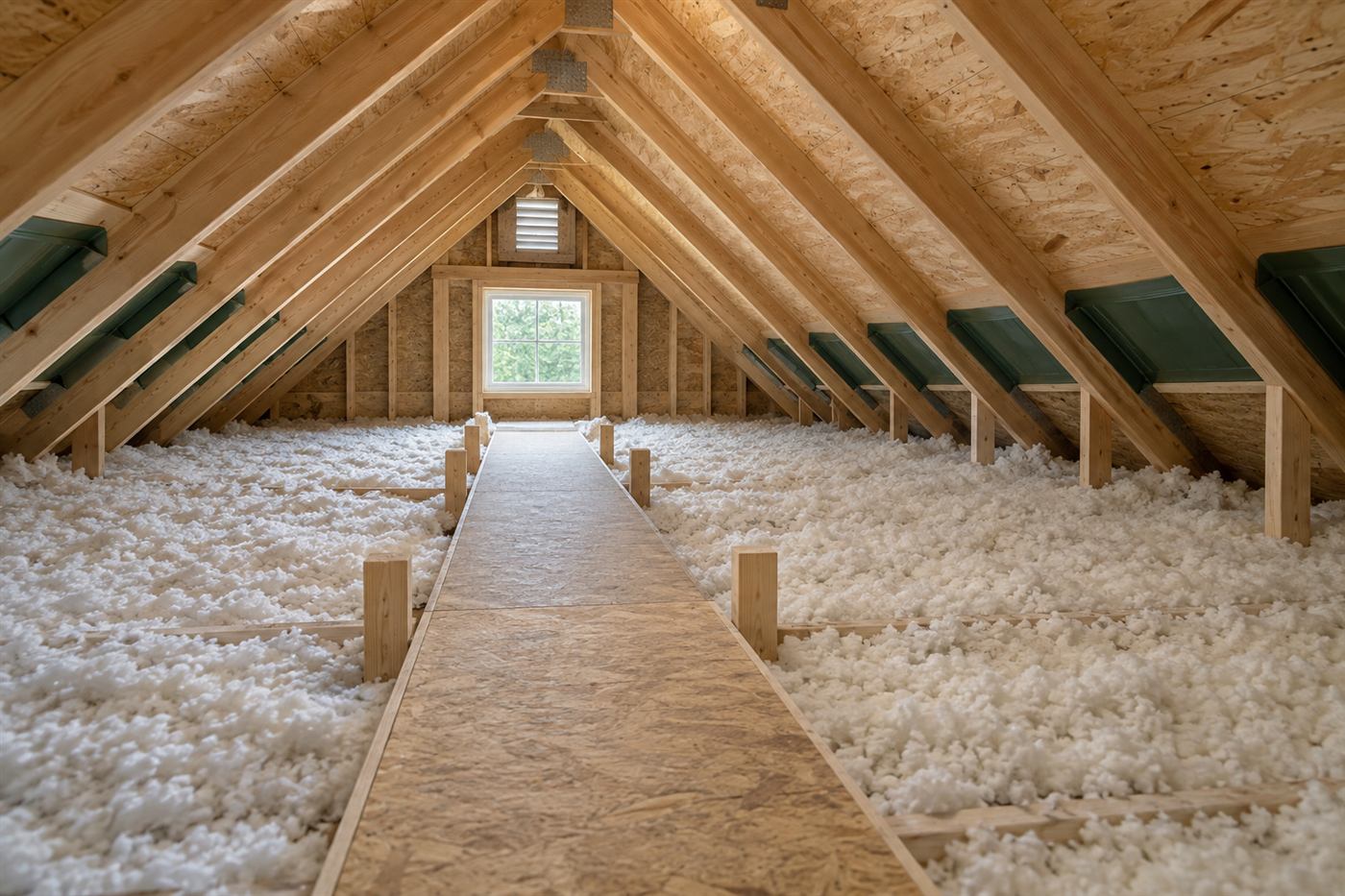
What a radiant barrier actually does in a Fort Lauderdale attic
Heat reaches an attic in three ways. It conducts through solid materials, it moves with air, and it radiates from hot surfaces toward cooler ones. On a bright summer afternoon the roof deck over a Fort Lauderdale house gets very hot, and that hot wood radiates energy down toward the attic floor, the ductwork and everything stored up there. Standard insulation slows conducted heat. It does very little about radiated heat, because the radiation lands on the top surface of the insulation and gets absorbed there.
A radiant barrier is a thin, highly reflective surface, usually aluminum foil bonded to a backing or a reflective coating, installed so it faces an open air space. When the underside of the roof deck is covered with it, much of the radiated energy is reflected back toward the roof rather than emitted into the attic. The attic air stays somewhat cooler, the insulation on the floor sees less load, and any air handler or duct run sitting in the attic works in a gentler environment.
It helps to be honest about the limits. A barrier does not stop conducted heat, it does not seal air leaks, and it does not replace insulation. It is one layer in a system, and the reason it gets recommended in South Florida is that the sun here is intense for most of the year, so radiant load is a larger share of the total heat gain than it would be in a cold climate. A technician looking at your attic will tell you whether a barrier is the right first move or whether insulation depth, air sealing or duct repairs should come first.
Canal lots, waterfront homes and the humid air problem
Much of Fort Lauderdale was built around water. Homes on canal lots in neighborhoods east of the interstate, and the waterfront properties along the Intracoastal side, live in air that is more humid and often saltier than inland air. That matters for any material installed in an attic. Foil can corrode if it is poor quality or if moisture condenses on it repeatedly, and any layer that traps damp air against wood can start a moisture problem of its own.
For that reason a good installation on a waterfront house pays attention to airflow before anything else. Soffit vents must stay open. The air path from soffit to ridge or gable must not be blocked by foil or by loose insulation. The barrier should be installed so it does not seal off the roof deck from air movement in a way that traps moisture, and where a house has a history of roof leaks, the leaks should be fixed first. A barrier stapled over a damp, stained deck only hides evidence you would rather see.
Reflective materials sold for this work are often perforated for moisture vapor to pass through. A technician can explain which type suits your roof deck and your ventilation. If you live on a canal and notice musty smells in the attic, rusty fasteners or dark staining on the underside of the deck, mention it on the phone. That tells the team to plan an inspection visit before any quote is discussed.
- Check that soffit vents are clear of old insulation before anything is installed
- Ask what the reflective product is made of and how it handles moisture vapor
- Report any past roof leaks or stained decking when you call
- Keep ladders and stored boxes away from the attic hatch so access is easy
Flood-zone construction and what it means for attic work
Many Fort Lauderdale properties sit in mapped flood zones, and homes there are sometimes raised, built on pilings or fill, or have living space arranged very differently from a typical slab house. That does not change the physics of a radiant barrier, but it changes the practical side of the job. Some raised homes have steeper roofs, some have limited attic access, and some have been renovated several times with additions that created separate attic sections with different heights and different insulation.
An addition is a common detail. The original house may have a modest attic with old batts, while the addition has a low-slope section with spray foam or nothing at all. A single quote for the whole roof rarely makes sense. A technician usually walks each attic zone, notes where the roof deck is reachable, and decides whether a barrier belongs in one section, several or none.
If your property is in a flood zone, mention if you have been through water damage in the past. Insulation that got wet and was never replaced is a separate problem from heat, and our page on insulation after water damage explains why that needs attention first. A radiant barrier is not a repair for wet or compromised materials, and installing over them wastes the work.
Mid-century neighborhoods and the houses behind them
Parts of Fort Lauderdale are full of mid-century single-story homes with concrete block walls, low-pitch roofs and shallow attics. These houses were built when cooling was an afterthought, and the attic cavity is often tight. In a shallow attic a technician cannot always crawl comfortably, and the distance between the roof deck and the insulation can be only a foot or two in places.
That tight space affects method. A foil product stapled to the underside of the rafters needs room to work, and a reflective coating applied by spray needs enough access to reach the whole deck evenly. In some low attics the better answer is to improve the floor insulation first and treat the roof deck second, or to look at air sealing around the ceiling penetrations that let hot attic air leak into rooms.
These older houses frequently have ductwork running through the attic, sometimes in poor condition, with seams that leak into the hot space. A barrier lowers the temperature around the ducts, which helps, but leaky or crushed ducts are still leaky or crushed. When we talk through your situation on the phone, expect questions about whether your air handler is in the attic, how old the ducts are, and whether rooms at the end of a run stay warm.
Where a barrier helps most, and where it does little
A radiant barrier earns its keep when the roof deck gets very hot and the attic below it is large, open and holds mechanical equipment. A dark shingle roof on a single-story Fort Lauderdale house with the air handler and ducts in the attic is a good candidate. So is a house where upstairs rooms or the rooms directly under the roof get noticeably warmer than the rest of the home in the afternoon.
It does less when the attic is already conditioned by spray foam on the roof deck, because the deck is sealed and the attic temperature is moderated. It does less where the roof is highly reflective already, such as light-colored tile or a white coating, and it does less in a house with almost no attic space. In those cases money is better spent elsewhere. Our guide on attic insulation in Fort Lauderdale covers when adding depth to the floor insulation is the better first step.
The honest answer to where it helps most is that it depends on the roof, the attic, the equipment and how the house is used. A short phone conversation will sort out most of that, and an on-site visit settles the rest.
| Situation | Radiant barrier likely useful? | Why |
|---|---|---|
| Dark shingle roof, air handler in attic | Often yes | Hot deck radiates toward ducts and equipment |
| Spray foam already on roof deck | Rarely | Deck is already sealed and moderated |
| Very shallow attic with little access | Depends | Installation method is limited by space |
| Light tile roof with deep attic insulation | Sometimes | Radiant load is lower, other gaps may matter more |
| Active roof leaks or damp decking | Not yet | Repair the roof and dry the deck first |
How installation is typically approached
There are a few common ways to add a radiant barrier. One is foil-faced material stapled to the underside of the rafters or trusses, leaving an air gap between foil and deck edge. Another is a reflective coating sprayed onto the underside of the roof deck. A third is laying foil across the attic floor over the insulation, which is a method many installers avoid in humid regions because dust settles on the foil and moisture can collect there.
For a Fort Lauderdale attic, the underside-of-deck approach is the one most often discussed because it keeps the reflective surface facing open air and out of the dust. The crew works from inside the attic, takes care around wiring, recessed lights and gas flues, and keeps all vents clear. They avoid covering anything that must stay open to air, and they leave the ridge and soffit paths intact.
Throughout the work a technician should wear proper protective gear, because attics in summer are hard on the body and the materials create dust. Homeowners rarely need to be inside the house for the whole job, but someone needs to be reachable and the attic hatch must be accessible. The specifics of scheduling, access and what to move out of the way are covered on the phone before anyone is dispatched.
What a technician checks before recommending anything
A visit to a Fort Lauderdale attic begins with the roof deck. The technician looks at the type of decking, whether there are stains or soft spots, how the rafters are spaced and how much clear air space exists under the deck. They look for old foil that may already be there, since some houses already have a barrier that has aged or been covered with debris.
They check the existing insulation: type, depth, whether it is compressed, whether it is damp, and whether pests have disturbed it. They look at the ductwork and air handler, at attic ventilation, at wiring that runs along the framing, and at any bath fan or kitchen exhaust that vents into the attic when it should not. These are all findings that influence what gets recommended and in what order.
If the technician finds something outside the scope of a barrier, such as a vent that dumps humid air into the attic or leaking ducts, they will say so plainly. A recommendation to fix those things first is a sign the visit is doing its job, not a way to add work. You should leave with a clear picture of what the attic looks like and which steps make sense.
- Roof deck type, condition and staining
- Existing insulation type, depth and condition
- Ductwork, air handler location and leaks
- Ventilation paths at soffit, ridge and gable
- Wiring, recessed lights and flues that need clearance
- Signs of past or present moisture
Hurricane season, storm damage and timing the work
Fort Lauderdale owners plan around hurricane season, and attic work is no exception. Roof repairs after a storm can disturb a barrier, and a new roof installed over an existing deck can change how the attic behaves. If you are planning a roof replacement, it is smart to think about whether the barrier should wait until the new deck is in. Our page on insulation after roof replacement explains the sequence that usually works best.
After a storm, check the attic before you book any insulation work. Look for water stains, drips along rafters, daylight where there should be none, and damp insulation. Anything like that should be handled by a roofer first. A reflective layer over a wet deck can hold moisture in and hide a leak that keeps growing.
Outside storm periods, scheduling is generally simpler, and the work is more comfortable for everyone when the attic is not at its hottest. Technicians often prefer to start early in the day for that reason. When you call, say whether you have a storm plan, a roofing project on the calendar or a recent repair, so the visit can be sequenced sensibly.
Quotes, on-site visits and the service call charge
Quotes for this work are given by phone only, and no price appears on this site. A simple job that fits a standard description can often be discussed after a few questions about your roof, attic size and equipment. Anything more complicated, such as multiple attic zones, an addition, awkward access or signs of moisture, needs an on-site visit so the technician can see it before a quote is given.
There is a service call charge for a visit, and it is explained on the phone before anyone is dispatched. That way there are no surprises, and you can decide whether to go ahead with the visit. We do not promise arrival windows, and we will not push a visit if the phone call shows that something else, like a roof repair, should come first.
To make the call useful, have a few details handy: the approximate age of the house, whether the air handler is in the attic, what kind of roof you have, and any rooms that run hot. If you can safely take a few photos of the attic from the hatch, that helps, but do not climb into a hot attic or step on drywall to get them. Then call, and we will talk it through.
Questions to ask before you say yes to any installer
Any radiant barrier job deserves a few direct questions. Ask what product is being used and how it is fastened. Ask how the installer protects ventilation paths, and how they handle recessed lights, bath fan ducts and wiring. Ask who will actually be in the attic, whether the work is done by employees or sub-contractors, and what happens if something unexpected turns up, such as damaged decking.
Verify credentials yourself with the city or county, and ask for proof of insurance if a roof or structure is involved. Be wary of anyone who promises specific savings, specific temperature drops or a miracle result without seeing the house. Real results depend on the roof, the attic, the equipment and how the home is used, and a careful contractor will say so.
When you are ready to move ahead, call us, describe what is happening in your Fort Lauderdale home, and we will walk through whether a barrier makes sense, whether a visit is needed and what to expect from there.
Questions people ask
Does a radiant barrier replace attic insulation?
No. A radiant barrier addresses heat that radiates from the underside of a hot roof deck. Insulation on the attic floor slows heat that conducts through ceilings. In Fort Lauderdale they do different jobs and often work best together, though a technician may recommend improving the insulation or sealing air leaks before adding a barrier.
Will a barrier cause moisture problems in a humid canal-side home?
It can if installed badly. A properly planned installation keeps soffit and ridge vents open, uses a product suited to humid air, and avoids trapping damp air against the deck. If your attic already smells musty or shows staining, the moisture source should be found and fixed before any reflective layer goes in.
Can I install foil in the attic myself?
Attics get extremely hot, contain wiring, and have framing you can fall through if you step on drywall. We would not encourage a do-it-yourself job. A trained crew works with protective gear and knows how to keep vents and fixtures clear. If you want to help, clear access to the hatch and move stored items away from it.
How do I know if I already have a radiant barrier?
Some houses already have foil-faced decking or an older reflective layer. From the hatch you can often see a shiny surface on the underside of the roof deck. Dust can dull it, so it may look gray rather than silver. A technician can confirm what is there and whether it is still in good condition.
Do I need an on-site visit, or can you quote over the phone?
Simple jobs can sometimes be discussed by phone after a few questions about your roof and attic. Anything complicated, such as multiple attic zones, an addition or signs of moisture, needs a visit first. The service call charge is explained on the phone before dispatch, and quotes are given only by phone.
Should I wait until after a roof replacement?
If a new roof is planned in the near future, it usually makes sense to coordinate. A new deck or underlayment can change the attic, and work done before could be disturbed. Tell us about your roofing plans when you call, and we will help sequence the work so nothing is done twice.
Describe the situation by phone and we will tell you what the job involves. Quotes are given by phone. Jobs that cannot be quoted without seeing them need a technician on site, and the service call charge is explained on the phone before anyone is dispatched.
(561) 854-1888