Plantation's mature neighborhoods and what is in the attic
Plantation grew up in the 1960s and 1970s, and many of its streets still hold the ranch homes built then: single-story, concrete block, low-pitched roofs and wide overhangs, often on larger lots with established oaks, mahoganies and palms. The tree canopy gives these neighborhoods their character, and it also shapes what happens above the ceilings.
Houses of that era were built with little insulation by today's standards, if any. Over the decades, owners added batts, loose fill or blown material at different times, sometimes after a roof replacement and sometimes after an energy-bill scare. The result can be a patchwork where one room has a decent layer and the next has bare drywall under a thin gray dusting of ancient fibers.
Add the age of the material itself. After many years of Florida heat and humidity, old insulation settles, loses loft, absorbs dust and sheds fibers. Even where it looks intact, it may be doing a fraction of its original job. Whether to keep it, top it up or take it out depends on its condition, and that is something to be judged in person.
Old attic insulation: how to tell if it can stay
Old does not automatically mean bad. Clean, dry, evenly spread material that has simply thinned can often stay, with a new layer added over it. The goal of the inspection is to separate that from material that is actively harming the house.
A technician will check for moisture, odors, stains, pests and compaction. They will also check what the material is, because very old loose-fill products sometimes need extra care. If anything unusual shows up, such as a vermiculite-type product, they should stop and advise you before disturbing it, and testing may be recommended. This is not something to handle on your own.
- Can stay: dry, clean, mostly even material that is simply thin
- Should come out: wet, stained, moldy-smelling or soaked material
- Should come out: material fouled by animals or full of droppings
- Should come out: material crushed into hard mats or falling off framing
- Needs testing first: unusual or very old loose-fill products of uncertain type
Roof leaks after storms and branch damage
Tall trees are lovely until a storm comes through. Falling limbs can crack tiles, puncture shingles or tear at flashing, and even small branches scrape roofing surfaces over time. Leaves collect in valleys and against walls, hold water and speed the aging of roofing materials. A roof under heavy tree cover can stay damp long after the rain stops.
Older roofs on 1960s and 1970s homes are often on their second or third replacement, and the transition points between old and new work are classic places for leaks. Penetrations for plumbing vents, kitchen and bath exhausts and old antenna mounts add more weak spots. Water that gets in soaks the insulation first, and the ceiling stain you eventually see is a late signal.
After a storm, check the ceilings and walls for stains and listen for dripping. Do not climb onto the roof. If anything looks hazardous, such as a sagging ceiling or water near fixtures, stay clear and call for help. A roofer should stop the leak, and a technician can then assess the insulation. Our page on wet insulation after a hurricane describes how that decision is usually made.
Pests that come with the trees
Trees give animals a ladder to the roof. Squirrels and rats move along branches and cables, find a loose vent screen, a gap at a soffit or a damaged fascia board and settle into the warm, quiet attic. Insulation is perfect for them to burrow in, and a single winter or a few weeks of cooler weather can bring a surprising amount of activity.
The material they nest in gets tunneled, compressed, chewed and fouled. Urine and droppings soak into it, and the odor can linger long after the animals are gone. That odor often works its way into the house through ceiling gaps and fixtures. Cleaning in place does not work, and the contaminated material is normally removed.
Replacement should follow exclusion work. Sealing every entry point and trimming branches back from the roof are part of keeping them out. If you notice scratching at night, droppings near the hatch or chewed vent covers, avoid the attic and call for an inspection. Our page on rodent damage to insulation goes into more detail.
Ranch house construction and how it affects the job
Ranch homes spread out. The attic covers the entire footprint, usually in one long stretch with a low pitch. That means a lot of surface for heat gain, and a lot of material to move during removal. Attics may be reached through a hatch in a hallway or garage, and in some houses there is only one point of access, which means a long hose run and careful planning.
Low pitch means low clearance near the eaves, where technicians must crawl or work from the edges. Blocked soffits are common, because old insulation has drifted into them or because they were painted over. Clearing that and adding baffles can make a real difference in how well the attic breathes.
Ceilings in these houses may be drywall over wood framing, or in older cases plaster or other materials that need gentle handling. Wiring may be old, with cloth-sheathed cable or undersized circuits in some. A technician should flag anything that looks unsafe and not cover it up. If an electrician needs to look first, the insulation work waits until it is addressed.
What a technician checks and how you can prepare
On the visit, the technician inspects the attic, ceilings, roof underside, ducts and any exposed wiring. They look for moisture, pests, compaction and unusual materials. They check access and ventilation and decide what needs to be removed, repaired or sealed before anything new goes in.
You can help by clearing the space under the hatch, moving cars away from where the hose will be run, putting away valuables in nearby rooms and keeping children and pets in another part of the house. Do not enter the attic yourself, since the heat, dust and fragile ceilings pose real risks. Our visit preparation guide has a longer checklist.
- Describe the house, roof and symptoms by phone.
- Book an on-site visit if the job is complicated.
- Have the technician inspect and document the attic.
- Fix the source of leaks, pests or duct trouble.
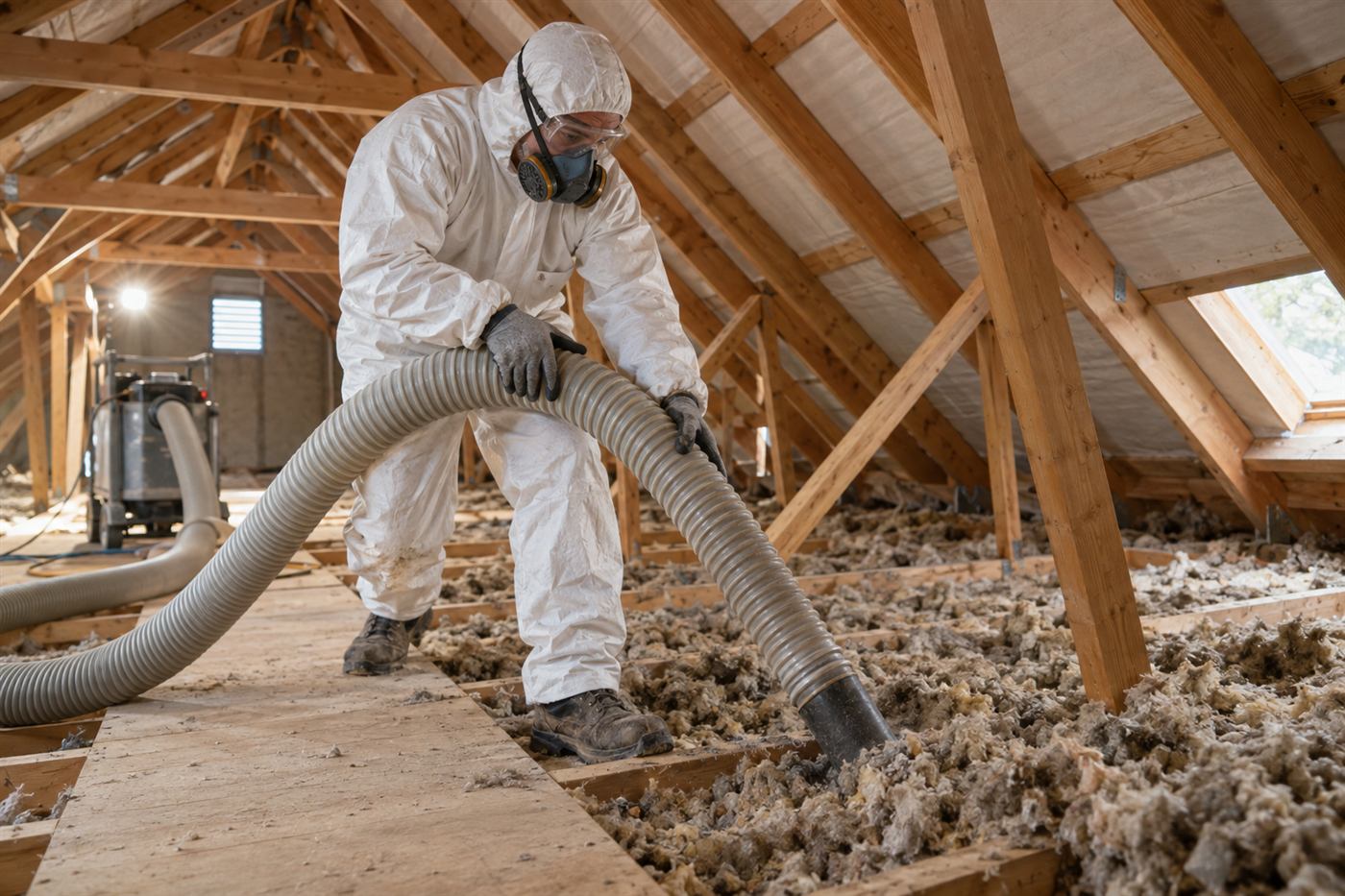
- Remove damaged material with a contained vacuum method.
- Seal air leaks, add baffles and install new insulation.
- Review the work and keep the photos and notes.
Choosing the new insulation
For most ranch attics with open joists, blown-in material is the practical choice, because it flows around framing, wiring and ducts and covers irregular areas well. Fiberglass and cellulose each have strengths, and a technician can explain which suits your attic. Our page on blown-in insulation in Plantation covers the details.
Radiant barrier can help where the roof deck bakes in afternoon sun, and our page on radiant barrier in Plantation explains how it fits alongside insulation. In some cases, spray foam is considered, though it needs careful planning for ventilation and roof structure.
Whatever the material, air sealing should come first. Gaps around fixtures, plumbing stacks, wiring holes and the attic hatch let heat and humidity through. Closing them before the new layer goes in makes the whole system work better.
Ducts, air handlers and old equipment
Many Plantation homes have had their air conditioning replaced at least once, and ducts from earlier systems may still be in the attic, sometimes abandoned, sometimes patched into new work. Old ducts leak at joints, and cold supply lines sweat in humid air. Water from that sweat can soak insulation beneath the duct paths for years.
If your attic shows staining along duct lines, the duct problem needs fixing along with the insulation. A qualified HVAC contractor handles duct repair and replacement. A good insulation crew will point out what they find and coordinate rather than cover it over.
If your air conditioner struggles on hot afternoons, a technician looking at the attic can often tell whether poor insulation, leaky ducts or both are contributing. Insulation helps, but it is part of a system.
Garages, additions and the odd corners of a ranch house
Plantation ranch homes have usually changed since they were built. Garages were converted to family rooms, screened porches were enclosed, bedrooms were added at the back and carports became garages. Each of those changes created a seam in the ceiling and attic, and the insulation at those seams is often the weakest in the house. Material was cut to fit, left short or never installed at all above the new space.
Converted garages deserve a close look. The ceiling may be a single layer of drywall under an old roof structure with little more than a thin layer of material above it. Additions may have their own flat or low-pitch roofs with limited clearance, and old exterior walls that became interior ones may hide stained or damaged material.
A technician walking the attic should trace where the old building ends and the additions begin. Removing damaged material at those junctions and bringing the whole attic to a consistent level helps rooms feel the same, instead of having one hot corner. When you call, mention any additions, conversions or work done by previous owners, even if you are not sure of the details.
After the work: keeping the new layer in good shape
New insulation lasts longer when the attic is treated gently. Keep storage out of the attic where possible, since boxes crush the material and people walking to retrieve them make it worse. If you must store things, ask for a platform or walkway boards that sit above the insulation rather than on it.
Ask air conditioning technicians to stay on the walkway and to tell you if they see anything unusual. Have the roof checked after major storms, and keep tree limbs trimmed back from the roofline. Look at the ceilings after heavy rain, and report stains early. A small stain caught quickly is far easier to handle than a wide patch discovered months later.
A look from the hatch once a year, without stepping in, is enough for most owners. You are looking for dark patches, droppings, a changed smell or insulation that appears to have moved. If you see any of those, call, and we will talk through what they might mean.
Permits, quotes and getting started
Permit rules depend on the scope of work and the city. Straight insulation work is often treated differently from jobs that open structure or accompany a re-roof. Ask the contractor how permits are handled for your address, and confirm with the city if you are unsure.
Quotes are given by phone only. For simple jobs, we can often talk through a description. For complicated jobs, an on-site visit is needed first, with a service call charge explained on the phone before dispatch.
When you call, tell us about the house, the roof, any leaks, storms or pest signs, and what the attic looks like from the hatch. Photos taken from the opening without entering the attic help. When you are ready, call Boca Raton Insulation and describe what is going on at your Plantation home. We will go over the next step plainly.
Questions people ask
My attic insulation is decades old but looks fine. Does it need to come out?
Not necessarily. Clean, dry and evenly spread material that has simply thinned can often stay, with a new layer added on top. Removal is better when material is wet, stained, smelly, fouled by animals or crushed. A technician can tell the difference during a visit and explain which applies to your attic.
What if the old insulation is a type I do not recognize?
Do not disturb it. Very old loose-fill products can contain materials that call for testing before anyone handles them. Tell us what you can see from the hatch, and a technician will advise on the safe next step. Testing is arranged first if there is any doubt about what the material is.
Do tree branches really cause roof leaks?
They can. Branches scrape and crack roofing, leaves hold moisture in valleys and falling limbs can break tiles or flashing. Shaded roofs also stay damp longer and age faster. A roofer can check the surface, and a technician can see whether water has reached the attic insulation below.
Can I keep using my air conditioner during removal?
Usually, though the crew may ask to turn it off briefly near the air handler for safety or to protect the system from dust. Discuss it when scheduling, especially in hot weather. The technician will tell you what is needed for your setup so you are not left without cooling longer than necessary.
Will old wiring be a problem?
It can be. Cloth-sheathed cable, open splices or overloaded circuits should not be buried under new insulation. A technician will flag what looks unsafe, and a qualified electrician should look before the work continues. Do not touch or move wiring yourself, and keep material away from it until it has been checked.
How do I get a quote?
Quotes are given by phone only. Simple jobs can often be discussed from a description, while complicated work needs an on-site visit first. A service call charge applies for that visit and is explained on the phone before dispatch. Call with details about your home and what you are seeing.
Describe the situation by phone and we will tell you what the job involves. Quotes are given by phone. Jobs that cannot be quoted without seeing them need a technician on site, and the service call charge is explained on the phone before anyone is dispatched.
(561) 854-1888Related pages
Working carefully in a mature ranch attic
Plantation's established neighborhoods often have attics that have been added to, patched or reworked over decades. That history shapes the removal. The crew expects to find mixed materials, older wiring runs, and framing that has been notched for past projects. They work from the hatch outward along safe walking boards, noting where earlier repairs have left gaps or where previous owners stored items under the material. Photos are taken as they go so you can see the real condition of the space without climbing up yourself. The crew would rather stop and talk through a surprise than keep going and leave you with a result you did not agree to.
Mature trees are part of the picture. Leaves and branch debris can collect at the roof edge and soffit vents, and in some cases fine litter has been blown into the attic itself. The crew checks that the soffits are open and not packed with debris or old material, because blocked soffits trap heat and humidity. Where vents are clogged, they tell you what they found and what could be done, without overpromising how much it will change the home's comfort. Keep your questions and notes together in one place, since they make any later conversation with a neighbor, inspector or buyer much simpler.
You can prepare by moving cars and trimming any low branches that block the path of the hose if you are able, clearing the hall under the hatch, and keeping pets inside a closed room. Let the crew know about any known leaks or noises overhead. The scope and any quote are explained before work begins, so you know what is being removed, what is being replaced, and what is simply being flagged for another trade to handle. None of this needs to be rushed, and a patient approach tends to catch the problems that a quick glance would miss.
The order of work that keeps repairs from being repeated
A good job follows a sequence, and skipping steps tends to cost more later. First comes inspection and photographs of the existing layer. Second is containment of the house, covering floors and sealing returns. Third is removal in lanes, followed by a detail pass around obstacles. Fourth is a close look at the bare framing, roof deck and penetrations. Only then comes sealing and, after that, new insulation. Each step builds on the one before, so the finished layer sits on a clean, sealed surface instead of covering old problems.
The tradeoffs along the way are worth discussing openly. Removing everything is thorough but disruptive; removing only the worst sections is faster but leaves older material in place. The crew explains which approach fits your attic, based on what they found, rather than defaulting to the biggest job. If part of the attic is reachable only by crawling in tight spaces, they will say what is feasible and what would need extra work or may be left alone for safety. Ask as many questions as you like during the walk-through, because a clear picture of the plan makes the whole visit calmer for everyone in the household.
Afterward, the attic is left tidy, with the hatch resealed and the house cleaned along the route. You get a clear summary of the work done, and any items flagged for other trades are listed. Keep that record with your house papers. If you sell, an organized account of the attic condition and the work completed can answer a buyer's questions quickly and save back-and-forth during inspection. Photographs taken along the way give you something concrete to look at, which is far more useful than a verbal summary after the crew has left.