Why Tamarac attics need a different plan
A large share of the housing in Tamarac is built around the single-floor lifestyle: villas, patio homes, garden-style condominiums and clustered townhouse rows that were designed with retirees and seasonal residents in mind. The result is an attic layout that you do not see in a typical two-story suburban house. The roof is often one wide, low-slope deck that covers several units, and the attic space above your ceiling may be separated from your neighbor's only by a thin partition, or by nothing at all.
That matters for insulation because blown-in material is applied as a loose layer across the ceiling, and a layer is only as good as its edges. Where a shared attic has a firestop or a draft stop, the insulation has to be brought up to it cleanly. Where the partition is incomplete, a technician has to decide what can be done within your unit's footprint and what has to be raised with the association. Neither of those questions comes up when you are insulating a freestanding house, which is why a Tamarac attic deserves a short walkthrough before anyone talks about material.
- Low-slope or shallow-pitch roofs leave little headroom near the eaves.
- Shared roof structures mean one attic can serve several units.
- Single-floor living puts the whole interior directly under the ceiling insulation, so every gap shows up in comfort.
- Older communities often have insulation that was laid in once and never touched again.
What blown-in insulation actually is
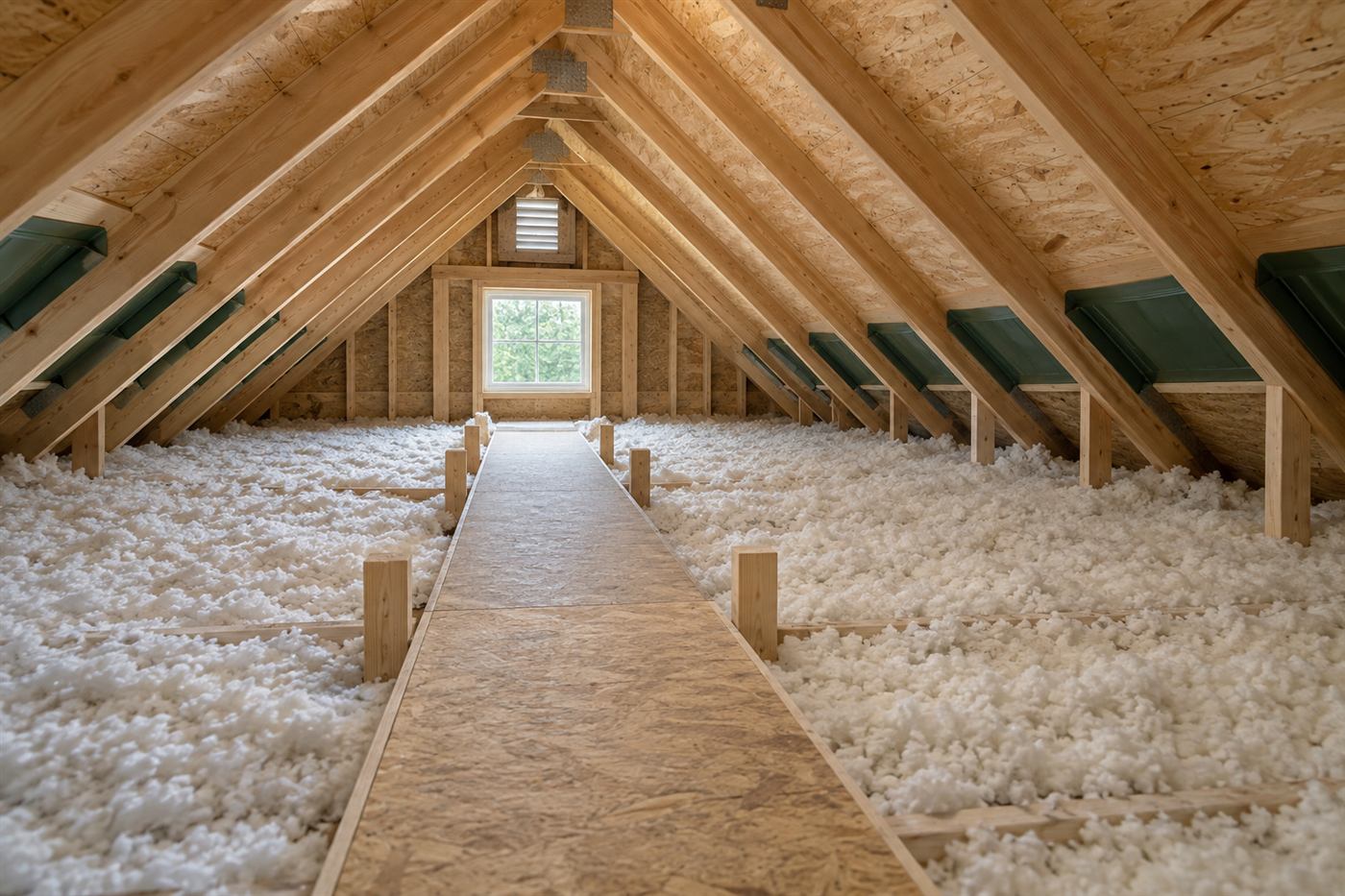
Blown-in insulation is loose-fill material, usually fiberglass or cellulose, that is fed through a hose and machine and distributed over the attic floor. Because it is loose, it flows around wiring, ductwork, truss webs, junction boxes and the odd framing detail that makes batt insulation awkward. It fills voids that a pre-cut roll leaves behind, and it can be added over an older layer without tearing anything out, provided the older layer is dry and sound.
The material is not a single product. Fiberglass loose-fill is light, does not absorb water the way paper-based products do, and is the more common choice in humid South Florida attics. Cellulose is denser and is made from recycled paper treated for fire and pest resistance, and it can be a good fit in certain conditions. Which one suits your Tamarac attic depends on the roof ventilation, the history of leaks, the access hatch and what is already up there. A technician should explain the choice in plain terms rather than simply naming a brand.
Coverage details that decide the result
Loose-fill performance is a matter of depth and evenness. The material is rated by how thick it is when it settles, so the installer works to a target depth for the product being used and the thermal level you want. A thin spot over a bedroom corner or a thick pile over the hallway does not average out: heat finds the thin spot. That is why coverage should be checked across the whole attic rather than at the hatch where everyone looks first.
In a villa or garden condo, the attic often runs in a long rectangle with the air handler or a platform somewhere in the middle. The edges near the soffits are the hardest areas to reach and the places most often left short. A competent crew will use baffles or rigid stops to hold the material back from vent openings so the soffit airflow stays open, and then bring the loose-fill up to the baffle. If your attic has no soffit vents at all, which happens in some older attached buildings, the plan changes and you should hear about that before the job starts.
- Photograph the existing insulation and note the visible depth.
- Mark the hatch, air handler, ducts and any platforms that need protecting.
- Install vent baffles at the soffits so airflow is not blocked.
- Blow the material in rows, working back toward the access point.
- Check depth against marked rulers and correct thin areas before leaving.
Shared roofs, association rules and who decides
In a condominium or a villa community, the roof and the attic space are often classified as common elements, even though the ceiling of your unit is yours. That means access to the attic may require a request to the association or the property manager, and some communities coordinate roof and attic work so that vendors are not walking across the same trusses at random.
Before the visit, it helps to find out three things. First, whether your unit's attic is reachable from inside your home through a hatch, or only from a common access point. Second, whether the association has a vendor list, insurance requirement or notice rule for work above the ceiling. Third, whether any recent roof work has been done and whether the contractor left records. None of these are obstacles, and all of them are easier to settle before a crew arrives with a truck and hoses than after. When you call, mention the community name and the building type so the scheduling conversation starts in the right place.
- Ask for the association rules on vendor access to common attic space.
- Keep a copy of any condo or HOA approval with your paperwork.
- Find out whether the roof is under warranty to another party and what work may void it, since that is a question for that party, not for an insulation crew.
- Tell neighbors if equipment will block shared parking for part of a day.
Humidity, moisture and what should be fixed first
Tamarac sits inland from the ocean but still in a climate where attic air carries a lot of moisture for much of the year. Insulation does not cure a moisture problem, and in some cases it hides one. Before material goes in, a technician looks for stained decking, rusted nail tips, damp insulation, mold-like growth, wet ceiling drywall and signs of a roof leak that has been patched or ignored.
If the existing material is wet or has a long-standing mold-like odor, adding more on top is the wrong move. The correct sequence is to find the water source, have the roof or the plumbing dealt with by the right trade, and then remove the damaged material before replacing it. A reputable crew will say so out loud, even when it means the job gets split into steps. If you are not sure whether what you see is damp or simply old, take photos and share them on the phone so the conversation can start with real information.
Air conditioning condensation is another common source. A drain line that has backed up, or a duct with a torn wrap, can soak the area directly below it for years. Those spots should be marked and repaired before they are covered.
Ducts, the air handler and the attic floor
In many Tamarac villas the air handler sits in the attic or in a closet that opens to it, and the ducts lie right across the ceiling joists. Blown-in insulation is usually laid over and around those ducts, which is helpful because it buries the supply lines in a thermal blanket. It is also a reason to look at the ducts first: torn wrap, loose connections, crushed flex and disconnected boots all waste cooling no matter how much insulation sits on top.
A technician should check that duct connections are secure and that nothing is crushed by foot traffic before material goes over them. Burying a disconnected duct makes later repair harder. If your cooling system feels weak in one room while the others are fine, mention that when you call. It may point to a duct problem the insulation visit can flag, even though duct repair itself belongs to an air-conditioning contractor.
Keep a clear route to the air handler. Insulation should not be piled against the unit, around the electrical disconnect or over its service panel, and a walkway board or marked path should remain so that future technicians can reach it without compressing the material.
Recessed lights, fans and other obstacles
Ceiling penetrations are where loose-fill gets complicated. Older recessed lights in a Tamarac ceiling may not be rated for insulation contact, and they often leak air from the room into the attic. Bath fans that were never ducted outside, or that vent into the attic space, push humid air directly into the insulation. Wire junctions, whole-house fan openings and chimneys or flues, where present, need clearance too.
A careful crew uses barriers around anything that produces heat and leaves proper clearances, then seals what can be sealed before covering. If the fixture itself is outdated, replacing it is a job for an electrician rather than the insulation crew, and it is sensible to deal with it first. Do not attempt to cut or rewire fixtures yourself from above the ceiling: live wiring, loose boards and a narrow attic are a risky combination.
- Ask whether recessed fixtures in your ceiling are rated for insulation contact.
- Confirm that every bath fan duct reaches the outside, not just the attic.
- Note any area where you can feel air moving at the ceiling on a windy day.
- Leave electrical decisions to a qualified electrician.
Single-floor living and the comfort payoff
In a one-story home the attic is your only roof-facing surface for the entire living area, so the ceiling insulation does more of the work than it would in a two-story house where upper floors shade lower ones. In summer the attic can run far hotter than the outdoor air, and that heat pushes down through the ceiling toward the people sitting beneath it. Uniform coverage is what keeps the warmest hours of the day livable without the air conditioner running constantly.
Many Tamarac owners are in the building for the cooler months only, or spend long periods away. That changes how you judge the work. You may not be there to notice a thin spot or a drip, so it is worth asking the technician to leave a short written note of what was found, what was done and what remains. Photographs of the before and after state of the attic are the simplest record, and they help the next person, whether that is you in a year or a buyer later.
Comfort is also a matter of noise. A well-filled attic reduces some of the sound that travels from the roof, which people sometimes notice during rainy season downpours. That is a side benefit rather than the purpose of the job.
What the visit looks like and how to prepare
A first visit is mostly looking. The technician goes into the attic with a flashlight, a camera and a measuring tool, checks the depth and type of what is already there, looks for moisture and pest signs, notes the ducts and obstacles, and works out how much area needs covering. Back at your door, they explain what they saw in ordinary words and tell you what the work involves. Quotes are given by phone after that conversation, and anything complicated may need an on-site visit. A service call charge applies to visits and is explained on the phone before anyone is dispatched.
To prepare, clear the path to the attic hatch, make sure there is lighting or a place to set equipment, and tell the office about pets, windows that open, or anyone with health sensitivities to dust. If the job goes ahead, the crew will cover floors on the way in, run hoses from the truck and protect fixtures. Expect some noise from the machine and a little dust at the hatch. Afterward, the crew should leave the hatch sealed or weatherstripped and the walkway clear.
- Clear a path from the front door to the attic hatch.
- Secure pets and move fragile items away from the hatch area.
- Find any paperwork about earlier roof or insulation work.
- Check association rules for vendor access and parking.
- Be ready to describe any hot rooms, leaks or smells.
When loose-fill is not the right answer
Blown-in material is a strong choice for a flat attic floor, but it is not right everywhere. Sloped ceilings, knee walls and closed cavities call for different methods. Attics with very low clearance can make it impossible to reach the edges safely. Some roofs are better served by a different approach altogether, such as foam applied under the roof deck, which changes how the attic behaves and needs its own evaluation.
Likewise, if the current insulation is fine but the real issue is air leakage, adding more loose-fill will not solve the problem. Sealing the gaps at top plates, around pipes and around lights comes first, and the layer goes on afterward. You can read more about that on the air sealing page, or compare materials in the spray foam and blown-in guide. For a broader look at depth and thermal levels, the attic insulation depth guide is a good starting point.
If you are still deciding, call and describe your building: villa, condo or townhouse, the approximate age, and what you see in the attic. A short conversation usually reveals whether loose-fill is a fit, whether a site visit is needed first, and what to gather beforehand. Call whenever you are ready and the office will walk you through the next step.
Questions people ask
Can blown-in insulation be added over what is already in my Tamarac attic?
Often yes, if the existing layer is dry, clear of mold-like growth and not packed down by water damage. A technician checks for moisture, pests and compression first. Wet or contaminated material should be removed before new insulation goes in, because covering a problem only hides it and can trap damp air against the ceiling below.
Do I need permission from my condo association before work above my ceiling?
In many communities the roof and attic are common elements, so a request to the association or manager may be required. Rules vary by building. Ask before scheduling, and keep any approval with your records. Mentioning your community name on the phone helps the office plan around access and parking.
Is fiberglass or cellulose better for a humid South Florida attic?
Both are used. Fiberglass loose-fill does not absorb water the way paper-based products do, which many owners prefer in humid conditions. Cellulose is denser and can work well in some attics. The right pick depends on ventilation, leak history and what is already installed, and a technician should explain the reasoning during the visit.
Will insulation fix a room that stays hot even with the air conditioner on?
It can help when the cause is heat coming through the ceiling, but hot rooms also come from duct problems, air leaks, poor airflow or an undersized system. A technician looks at the attic, ducts and ceiling together. If the cause is outside insulation, they should tell you and suggest the right trade.
How are quotes handled, and is there a charge for the visit?
Quotes are given by phone after you describe the building and the problem. Complicated jobs may need an on-site visit first. A service call charge applies to visits, and it is explained on the phone before anyone is dispatched, so there are no surprises when the technician arrives.
What should I do about a roof leak I found while looking in the attic?
Do not cover it with new insulation. Take photos, note where it is, and have the roof or plumbing source dealt with by the right trade. Once the area is dry and repaired, damaged material can be removed and replaced. Mention the leak when you call so the plan reflects it.
Describe the situation by phone and we will tell you what the job involves. Quotes are given by phone. Jobs that cannot be quoted without seeing them need a technician on site, and the service call charge is explained on the phone before anyone is dispatched.
(561) 854-1888